Barefoot In The Park
SPOILER ALERT: This essay contains plot details for Garden of Words.
SPOILER ALERT: This essay contains plot details for Garden of Words.
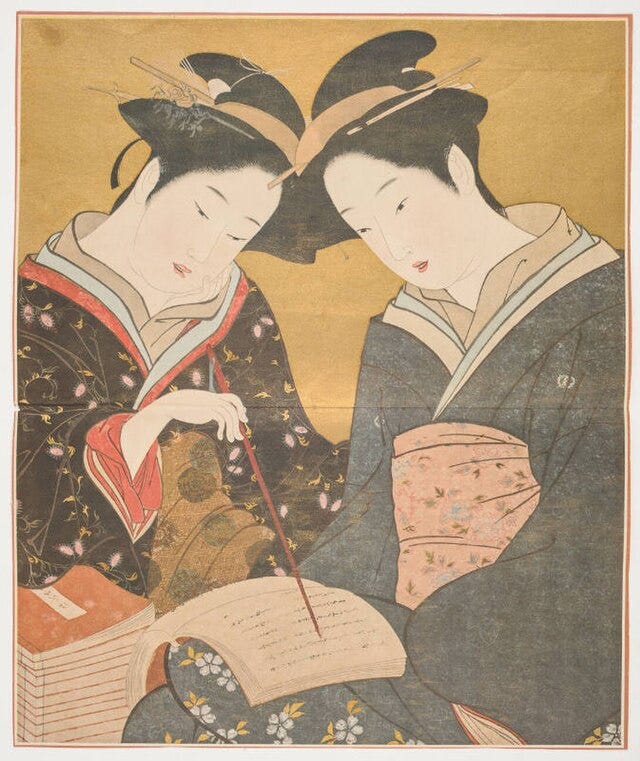
なるかみの, すこしとよみて,
A faint clap of thunder,
さしくもり,
Clouded skies,
あめもふらぬか,
Perhaps rain will come.
きみをとどめむ?
If so, will you stay here with me?
なるかみの, すこしとよみて,
A faint clap of thunder,
ふらずとも,
Even if rain comes or not,
わはとどまらむ,
I will stay here,
いもしとどめば。
Together with you.
- Man’yōshū vol. 11, verse 2514–2513.
It can be said that our dreams offer us the raison d’etre to live, while reality teases the possibility of bringing these dreams to fruition. Without the dream, what reason is there to live? Without reality, what reason is there to dream? The two need one another to thrive. This is how I saw Takao and Yukino in Garden of Words. One spends too much time in dreams. The other spends too much time in reality. The place where reality and dreams meet is the park. And only on rainy mornings.
While many will classify Garden of Words as a romance, it isn’t quite of a sort we are used to in movies, or elsewhere. It is a love that is not exactly platonic, nor quite erotic, either. It is a love of emotional survival. A salvation from a loneliness of the soul. About as much is to be expected when crafting a relationship between a fifteen year old boy and a twenty-seven year old woman. In most relationships of this sort, the context is either overtly sexual ( The Graduate), overtly rebellious (Harold And Maude), or outright predatory ( Lolita). Garden of Words is neither, as the age gap is used precisely to show the gulf in perspectives between Takao and Yukino.
Garden of Words is one of the few romances where I could empathize, almost completely, with the two “lovers.” Takao is a young dreamer, so passionate that he neglects the real world. Yukino is depressed, jaded by the ugliness of adult life. I have been in both of these roles, and I imagine that many of you reading this have as well. The roles of youth and elder also contradict one another. What struck me about Takao when first I saw the film was how mature and thoughtful he was for a fifteen year-old. What struck me about Yukino when first I saw the film was how young her voice was (her actress is Mayuri from Steins;Gate). Yukino also comments how she doesn’t feel any older at 27 that she did at 15. Stuck in adolescence. Both are desperate to grow in some way, to walk on their own, but don’t know how to do so.
Makoto Shinkai, the film’s director, had a particular “love” in mind when he crafted the film. He based it off of the traditional concept of “love” in Japan, known as koi, as opposed to the more modern concept of love ai. This koi, or “lonely sadness”, refers to “longing for someone in solitude.” This sort of love is particularly prescient in the works of Japanese novelist Haruki Murakami. Koi is certainly a presence in Garden of Words, as both Takao and Yukino are disconnected, to varying degrees, from reality. Takao knows that no one, not even his brother, can truly understand his love of shoe-making. While Yukino’s sense of taste has dulled to the point where she can consume only chocolate and beer. However, to focus so much on “lonely sadness” can distract from other side of this story, spiritual fulfillment.
When I say spiritual, I speak of finding someone you can connect to on an emotional and intellectual level. A partner more so than a lover. Yukino doesn’t say much about herself, but she listens, and that’s more than enough for Takao. She’s willing to treat his dreams with the seriousness they deserve, which is a rejuvenating elixir for anyone who’s been in that role. Takao allows Yukino to be a part of something, something small, perhaps, but even in the small things one can find value.
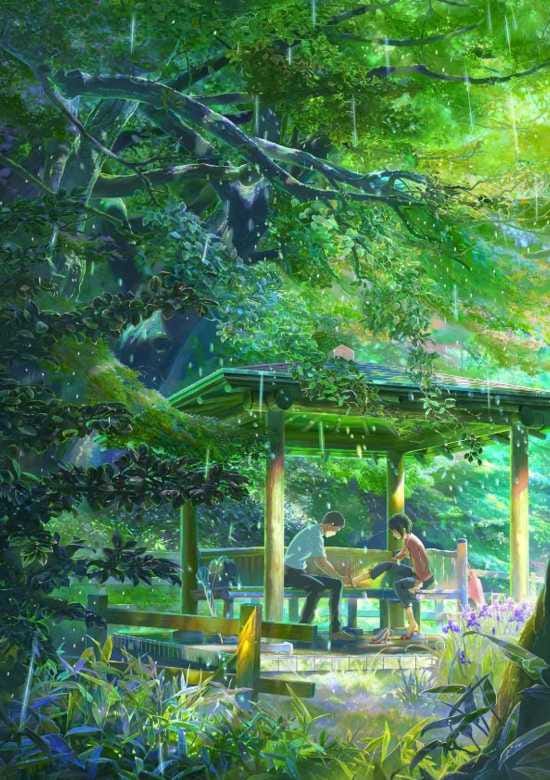
The scene that best signifies this is when Takao measures Yukino’s feet, the most divinely erotic scene of its kind since Madeleine’s unveiling in Vertigo. Sex can be best described as love made manifest, the complete surrender of one’s self to another person. Here, Yukino is doing just that. As anime critic, Allen Moody wrote, “Yukari offers Takao the part of her he wants most — her foot.” Though more so than this, Yukino is able to give his abstract wishes form and physicality. The moment when he first touches her foot, he is not only touching the object of desire, but also he touches desire itself. Viewers may find it strange that all this is communicated through the lens of feet, but these are the lens through which Takao sees the world. When you watch this film, you are asked to do the same. For instance, when first we see Yukino, we see her feet, guarded by shoes. When Yukino embraces Takao towards the end, spilling her emotions, she’s barefoot, just as she was when he measured her.
Every single frame of Garden of Words is worthy of being shown in a museum of modern art. So much so, that it almost seems a waste that they pass by the screen in the span of a few seconds. Mono no aware. The garden, modeled after a real park in Shinjuku, will go on to be one of the great centerpieces of animated film. Moody compared it to “deeper Narnia”, from the fantasy novels of C.S. Lewis, which “is supposed to look just like Narnia, except that everything is so much more vivid.” Indeed, the garden is almost otherworldly amidst the trains and skyscrapers. The thick of the trees seem to surround everything without and within, all hues of green light reflect on the outlines of your face. The smallest of subtleties are captured, from the falling of a twitching leaf to the scurrying insects that glide across the lake. Much like Francis Hodges Burnett’s children’s book, The Secret Garden, nature serves as a realm of the sacred, where the regular trappings and customs are unclothed, and therein we rediscover our true selves. Yet the garden is hardly the only natural force take touches the story. We contend with, also, the rain. In most features, with a notable exception being The Shawshank Redemption, rain is usually depicted as overwhelmingly negative force (quite popular during funerals). Here, the scattering raindrops add an air of beauty as they drizzle past the sun rays and stick, by the hundreds, to the top of Takao’s umbrella.
Towards the climax, the rains serve both as a means of cleansing and a means of catharsis. When Takao and Yukino meet for the last time in the garden, they are drenched in a downpour of rain. Upon returning to Yukino’s apartment, they briefly cast off their old clothes and speak with one another as openly as ever. Delightful conversation over a meal. The happiest moment of their lives, away from life itself. Takao helplessly confesses his love. Yukino blushes, but reasserts her role as a teacher. Life returns. Utterly dejected, Takao quietly exits, but Yukino rushes after him. He lashes out at her, feeling led on and pandered to. When we’re young, adults tell us to follow our dreams, that we can be whatever we want to be, but as we get older, we question if they really meant it.
Dreamers constantly demand reality for affirmation. Will we succeed or will we fail? Tell me now before I waste myself on a failed project. It is a conflict that exists not only with the dreamer against the world, but also the dreamer against him or herself. Takao is exhausted, and so are the rains. The sunlight breaks through on Yukino’s face. With no more clouds to hide behind, she embraces Takao, making a confession of her own. He saved her. The very act of being there, truly being there, with another human being, however briefly, made her alive again. What is reality without the dreams that make it? Special credit is due to Kana Hanazawa, who nailed this forceful performance in one take. (The English voice actress, Maggie Flecknoe, gives an equally moving performance, as well). They cry in each other’s arms. A reconciliation.
While lonesomeness has a presence, particularly with Yukino, it doesn’t quite delve into the fatalistic doldrums of Shinkai’s Five Centimeters Per Second. Indeed, it’s arguable that “koi” was better expressed there than in Garden of Words. If there is a Japanese concept that expresses itself well in Garden of Words, it is that of “kaizen”, or constant self-growth. Shinkai has said that this film doesn’t present “loneliness as a problem to be fixed,” (Interviews). Loneliness is accepted here as a natural condition of the human soul, one we must all experience from time to time. Yet it need not always be so terrible a thing, as Virginia Woolf once wrote, a woman needs “a room of her own if she is to write fiction.”
Just as the writer cannot express him or herself properly except with time alone, so too can’t anyone else. Yukino and Takao met one another at the crossroads of their lives. Both in the process of learning to walk. I’ve often heard it said that the best dating advice is to work on oneself. Reason being that if you lack a grasp of who you are as a person, then it’s unlikely you’ll handle intimacy with anyone else. Takao helped Yukino take the first steps to rediscovering her self-worth. Yukino helped Takao take the first steps to realizing his dream. Perhaps, after some time with themselves, they’ll be better people, more complete. With feet that walk unaided. As Shinkai has said, “The time one spends alone can help you sort out the thoughts in your mind.”
Consider the moment where a bird flies past a towering skyscraper, yearning for something beyond its own self, beyond its own life.
Bibliography
Shinkai, Makoto. “Interviews.” Garden of Words. Comix Wave Films. 2013 Blu-Ray.
Originally published at http://sansuthecat.blogspot.com.