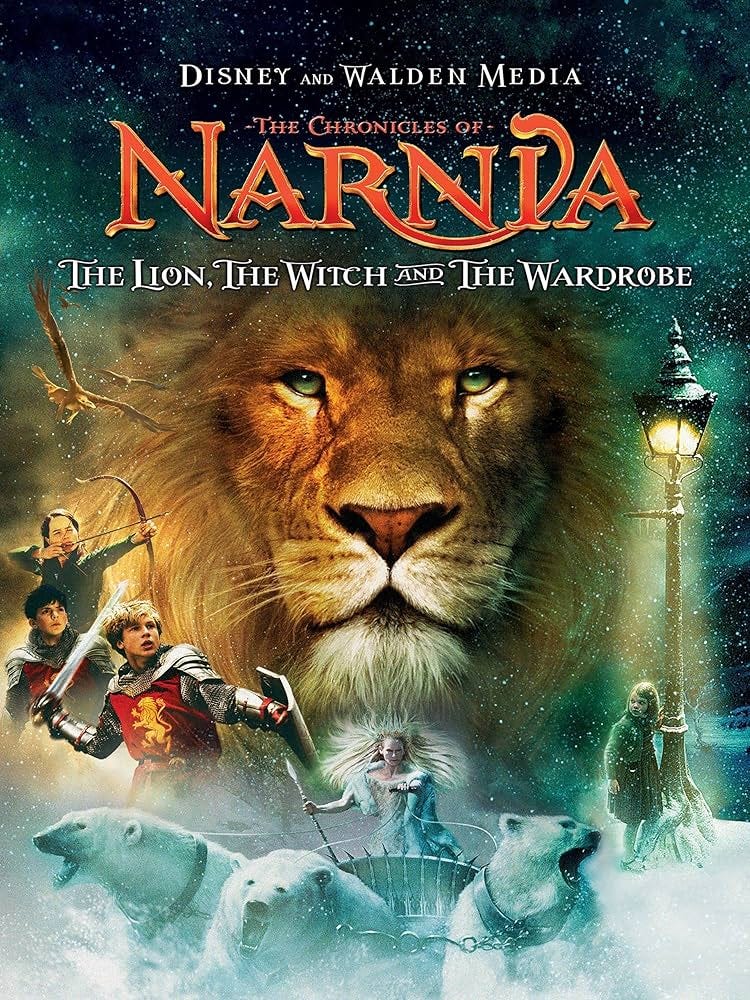
Entering the Wardrobe
Seventy-five years of The Lion, The Witch, and The Wardrobe

SPOILER ALERT: Plot details for the first Narnia book are discussed.
Narnia first taught me the language of fantasy. The language of escape. Whenever I go back to Narnia, I am inflamed with the joys of reading. If J.R.R. Tolkien’s Lord of the Rings was a modern myth, then C.S. Lewis’s Narnia is a modern fairy tale. It shouldn’t work, either. A portal fantasy set during the Blitz, talking animals out of Beatrix Potter, creatures from global myth and folklore, a Father Christmas who gifts weapons, an evil witch who echoes Andersen’s Snow Queen and Haggard’s Ayesha, and at last, a Lion who represents (and may even be) Christ Himself. The Lion, the Witch, and the Wardrobe does these things all at once, but far from feeling like a mixed up stew, it feels as natural and as rooted as any other fantasy.
I received the Narnia books as a First Communion gift. They were unfortunately arranged in chronological order and not publication order. So I tried reading The Magician’s Nephew first. I found it boring and couldn’t finish. It wasn’t until after entering a Christian middle school that Narnia was reintroduced to me. I was a little older, so the reading went down easier, but I recommend any new visitors to Narnia read the books in publication order. If you do that, you will start, not with The Magician’s Nephew, but with The Lion, The Witch, and The Wardrobe.
Like The Wizard of Oz and Alice In Wonderland, the book opens with a curious girl who finds herself in another world. Unlike Dorothy, Lucy Pevensie was not taken by tornado, and unlike Alice, she did not fall down a rabbit hole. She opened a wardrobe and entered a wintry forest. There she meets the faun Mr. Tumnus and they share afternoon tea together. Like many kids who read the Narnia books, I found myself wishing that I could escape into another world. What makes the world of Narnia so compelling is that it has so many other fantasy characters thrown into it. Every animal in biology can talk and every creature from myth and folklore can fight. Few other fantasies at the time, and even now, can have all these aspects arrayed so organically. Of course, when you’re a child reading Narnia, you think only of the adventure, and you think little of the danger that you’d likely face along the way.
Though The Lion, The Witch, and The Wardrobe is a children’s book, I would say that it has a better grasp on the nuances of good and evil than, for example, Harry Potter and Philosopher’s Stone. Don’t get me wrong here. J.K. Rowling’s debut is a classic in fantasy genre, but the villains (e.g. Draco Malfoy) can read like Saturday morning cartoon characters. (To be fair, this changes in the later books). In The Lion, the Witch, and Wardrobe, Lewis demonstrates to us how easily good people can be seduced into evil, but also how it can be overcome.
First there’s Mr. Tumnus, the faun who is kind enough to invite Lucy to his home for tea, but this is a trap. He intends to turn her over to Queen Jadis, because she wants to kill the humans who are prophesied to overturn her rule. Mr. Tumnus doesn’t do this because he supports the White Witch, but because he is afraid of her. The oppression of Jadis draws an obvious parallel to that of Nazi Germany, even down to the Secret Police who hunt down any who oppose her. It makes you wonder. How many people then, and now, are like Mr Tumnus, quietly complying with an evil they secretly despise? Mr. Tumnus, to his credit, lets Lucy go because he comes to know her and finds that his conscience won’t allow him to betray her. In Narnia, good and evil reveal themselves through their acts. Mr. Tumnus witnesses Lucy’s goodness and is compelled to help her. Lucy’s brother Edmund has the opposite experience.
Edmund is the most interesting of any of the children in the book. He starts off as a nasty child who thinks little of his siblings and constantly belittles Lucy. We’ve all known kids like Edmund, or maybe once we were like him ourselves. When Edmund goes into the wardrobe, he doesn’t encounter a faun, but Jadis, the White Witch who rules Narnia with an eternal winter. She is a two-faced character, who can be both motherly and fiendish, often snapping back and forth between these extremes. When Jadis first meets him, she speaks to him warmly, offering him Turkish Delight, and promising to make him a Prince. Yet when he enters her domain without his siblings, she scolds him for not bringing the others. When she drags him along on her hunt for the other Pevensies, he starts to see her true nature, “All the things he had said to make himself believe that she was good and kind and that her side was really the right side sounded silly to him now” (116). Lewis is saying here that if you stick around an evil person long enough, they’ll let you know. No deception lasts forever.
The foil for Jadis is the great lion Aslan, perhaps the most famous Christ figure in fantasy literature. While Frodo Baggins and Harry Potter must also bear their own crosses and “die” for the sake of overcoming evil, they are flawed humans who resemble less the Christ of the Gospels, and more the imperfect Christs of Saramago, Kazantzakis, and Moorcock. Aslan is Christ if he were to appear in a fantasy world. So when you read of Aslan in these books, you are meant to feel as though you are the presence of the Son of God. When the Pevensies first meet Aslan in his camp, they can hardly bear to look him in the eye, “People who have not been in Narnia sometimes think that a thing cannot be good and terrible at the same time. If the children had ever thought so, they were cured of it now” (128). God inspires both wonder and fear. Aslan isn’t a tame lion, he comes and goes as he pleases, but he is also forgiving. He allows Peter to recognize his harshness as an elder brother may have led Edmund astray. He also holds private confession with Edmund, a conversation which he never forgot.
Christians believe that Jesus died for the sins of all humankind so that we might be forgiven and enter into Heaven. In a similar way, Aslan must die in Edmund’s stead for his betrayal of his siblings, as Jadis has the right to put all traitors in Narnia to death. When Aslan goes to the Stone Table, he is mocked, shaved, and killed by the White Witch. It’s a terrible scene which only Lucy and Susan are witness to. Though Christ’s disciples slept while he prayed in the Garden of Gethsemane, the Pevensie sisters comfort Aslan on his long walk to the Stone Table. They are also the first to witness his resurrection, just as the Three Marys were the first to find Jesus’ empty tomb in the Bible.
The resurrected Aslan tells them that according to the Deep Magic, “when a willing victim who had committed no treachery was killed in a traitor’s stead, the Table would crack and death itself would start working backwards” (165). This triumph over death extends not just to Aslan, however. Christians believe that on the second day of his death, Jesus descended into Hell to free the saints who had been waiting for his coming. Likewise, Aslan breathes back to life all those good Narnians who had been turned to the stone by the Witch. With these revived warriors, Aslan proves decisive in defeating Queen Jadis’s forces at the Battle of Beruna.
It’s hard to think of a children’s fantasy today which doesn’t owe some debt to Narnia. Philip Pullman’s His Dark Materials responds to Narnia from an atheistic perspective, where eating the Fruit of Knowledge is a good act and God is a tyrant to be overthrown. J.K. Rowling’s Harry Potter also follows a child who finds a new world within in his own, and one just as eclectic in its borrowing from folklore and myth. Like Pullman, Rowling emphasizes growing up and maturity over childhood innocence. The disgraced Neil Gaiman’s own fairy tales, especially Sandman, carry that same magic of being swept up into a parallel world. (Gaiman even wrote his own response to Narnia in his short story “The Problem of Susan”). The imaginary world in Katherine Paterson’s The Bridge to Terabithia (maybe not fantasy in genre, but certainly in spirit), is named for the Narnian island of Terebinthia.
The anti-authoritarian message of The Lion, the Witch, and the Wardrobe still resonates today. C.S. Lewis believed that God gave us free will, as he wrote in his Broadcast Talks, “free will, though it makes evil possible, is also the only thing that makes possible any love or goodness or joy worth having. A world of automata — of creatures that worked like machines — would hardly be worth creating.” It is better for humans to do goodness by our own choice, than to be forced into performative righteousness by some tyrant, as he once wrote in On Stories, “I am a democrat because I believe that no man or group of men is good enough to be trusted with uncontrolled power over others. And the higher the pretensions of such power, the more dangerous I think it both to rulers and to the subjects.”
Of course, Lewis also understood that while free will increases our capacity for goodness, it also increases our capacity for evil, to quote again from his Broadcast Talks: “The better stuff a creature is made of — the cleverer and stronger and freer it is — then the better it will be if it goes right, but also the worse it will be if it goes wrong.” This contradiction is touched upon in the second Narnia book, Prince Caspian, when the title character laments to Aslan that he was not of a more honorable lineage. The Lion answers him thus, “You come of the Lord Adam and the Lady Eve. And that is honor enough to erect the head of the poorest beggar, and shame enough to bow the shoulders of the greatest emperor on earth. Be content” (229).
Lewis tells us that we must come to terms with this contradiction, but in Narnia, he also shows a way out. Mr. Tumnus and Edmund both turned from righteousness, but upon witnessing true good and true evil, they return to the light. Edmund, in fact, who starts the story as the nastiest child, achieves the greatest triumph by breaking the Witch’s stone-making wand. For better or for worse, humans are born with a great responsibility towards ourselves and towards others. In our own lives, we must learn to recognize good and evil and act accordingly. And perhaps like Lucy Pevensie, a little childlike curiosity might help us along the way.
Bibliography
Lewis, C.S. Prince Caspian: The Return to Narnia. Macmillan: New York. 1951. 229.
Lewis, C.S. The Lion, The Witch, and the Wardrobe. Macmillan: New York. 1950. 116, 128.