Favorite Films 2024
2024 saw the return of many great franchises and a few new surprises
I love movies. I go my local theater once a week. Sometimes I see great films and sometimes I see terrible ones. It can always be a bit of a gamble, but all in all, I can’t stay away from the popcorn.
I’ve decided to make a list of some of my favorite films of 2024. I’ll also be including films that may have premiered a year or two previously at film festivals, but didn’t get a wide release until 2024. I will also be including short films. Keep in mind that I am not a professional movie critic. I’m just listing my personal favorites. Given that I also live in Japan, many of the films listed are Japanese. It also takes a long time for foreign films to come to Japan (sometimes up to three years), so if there’s a foreign film that I haven’t listed yet, it likely hasn’t come to my corner of Japan. There will be some minor spoilers scattered throughout.
Now, without any further ado, onto the list:
Short Films:
Is Now A Good Time? is a black comedy short by Jim Cummings. It satirizes Marvel films and the PR issues they bring, particularly the questionable aesthetic merit and the kowtowing to China. That said, the film also humanizes those who work behind-the-scenes on these projects. That they’re perhaps as aware as we are as to how tired these films have become.
Midnight is a short film directed by Takashi Miike of Audition fame. Based on a manga by Osamu Tezuka, it is about a mysterious taxi driver who only works at night and finds himself in high-octane, wacky situations. The film was shot entirely on an iPhone 15 Pro, and while it’s essentially a glossy ad for a new Apple product, it’s an undeniably fun one.
No Clouds In My Summer is a production by Wong-Fu, who have been making films and comedy sketches on YouTube for well over a decade now. For many fans, Wong-Fu filled the lack of Asian representation in Western media. My favorite work of theirs is still the masterful Left On Shing Wong. No Clouds In My Summer is a surreal music video about an artist who looks back on his failed relationship.
Tokyo Solitude is a brilliant short film by Teemu Javinen and Dan Williams, which perfectly captures the contradictory zeitgeist of our age: Despite being more connected than ever before, we are also lonelier than ever before. It is beautifully shot, and virtually silent, almost like a meditative painting.
Closing Time is a horror short directed by Spencer Keller about a woman waiting an uncomfortably long for her boyfriend to come to a diner. The performances from the lead actresses (Adara Troop and Hailey Stubblefield) are what really sell the tension.
Nothing Happened is a witty film by Emma Jane Gray that looks at the grayer areas of sexism that many women experience. Almost every “sexist” incident that this character (Kaya Sankar-Card) goes through also has an “innocent” explanation. It cleverly shows how easily men and women can perceive the exact same events so differently.
Don’t Do It is a psychological thriller by Dean Parker about a mentally ill young man who suffers from “Nice Guy Syndrome.” The film allows us to have some sympathy towards this man, while also being disturbed by his obsessiveness with his crush. It’s a thoughtful look into an unfortunately common state of mind.
Big Take by Alex Brooks was shot on 16 mm film and a loved every luscious second of it. It’s about two thieves who end up in the same hiding place. It uses little dialogue and has a great ending.
Koreatown Ghost Story is produced by Alter, which specializes in horror shorts. This one stars comedian Margaret Cho as a masseuse who is looking for a wife for her dead son and has found just the girl to do it. The story has scenes of comedy, but it gets to be quite horrifying towards the end.
Adam’s Song is another beautiful short from Wong-Fu about a struggling musician and his desire to gain approval from his stoic father. It is a rough, but relatable watch for anyone who has pursued a creative career or has felt out of step with their parents.
Christmas, Every Day is a short documentary from The New York Times about the rising number of children who are becoming influencers. It’s a career that may provide children with fame and fortune, but at what cost?
Instruments of a Beating Heart is another NYT Op-Doc by Ema Ryan Yamazaki about Japanese elementary schoolers competing to join a performance of “Ode To Joy.” The short shows how Japan teaches its children at an early age how to learn from failure.
Runaways is a sublime animated short by AtenaHena that barely runs over a minute, but I’ll be damned if I wasn’t impressed with every frame.
To Become A Lion is an NYT Op-Doc about the amount of work it takes to be a lion dancer. Connections between kung-fu and lion dancing are made, as well as how this tradition has changed over the years.
The Vanishing of S.S. Willie is one of the many products of Steamboat Willie falling into the public domain, but unlike most of those cash grabs, this one is actually pretty good. The short is framed as a lost documentary which re-contextualizes the animal gags in the cartoon as a horror show. Very chilling stuff.
Welcome to Noxus — Bite Marks is essentially a trailer for the next League of Legends installment, but it’s so quality that I couldn’t overlook it. The series finale of Arcane, a revolution in animation, left me empty and wanting more. This short fills that need, with the beautiful action set-pieces which made Arcane so great. How well are these animators getting paid? They deserve a raise!
Invisible String/nothing/The Chase are three short films from Wong-Fu that are richly shot, tightly written, and achingly real.
Honorable Mentions (Full-Length Features)
Silent Love is the fascinating romance between a mute janitor and a blind college pianist. They communicate by means of touch. It’s a sweet film with elements of Cyrano de Bergerac, but has some ultraviolent moments which are rather shocking for a film of this nature.
Golden Kamuy may be the best-looking Japanese film of the year. Based on the manga by Satoru Noda, its success is indebted to other successful live-action manga adaptations, like Rurouni Kenshin and Kingdom. The story is about a veteran of the Russo-Japanese War who joins an Ainu girl in Hokkaido to find a lost treasure. The story does a good job of educating the viewer about Japan’s indigenous Ainu culture and has plenty of thrilling action scenes, my favorite being the sled chase.
Kingdom IV: Return of the Great Commander is the fourth installment of the Kingdom films. While I did enjoy it quite a lot, particularly towards the end, some of the seams in this blanket are starting to show. Unlike the Rurouni Kenshin quintet, the Kingdom installments no longer feel like films, but episodes in a TV show. The main character’s obvious lack of armor had also begun to annoy me.
Deadpool and Wolverine is the third Deadpool film and it’s just as irreverent and violent as the previous two. Deadpool and Wolverine make for an excellent duo, who play off of their different personalities. While the film does have its share of awkward fits and starts, it’s the most fun I’ve had at a Marvel film since Spider-Man: No Way Home.
Mononoke: Phantom in the Rain is an anime film which should not confused with Studio Ghibli’s Princess Mononoke. The movie is based on a 2007 anime about a wandering medicine seller during the Meiji Period who deals with ghostly creatures. Phantom in the Rain follows two women who join a cult in the inner chambers of a noble family. Naturally, there is a malevolent spirit afoot, but it’ll take a lot of runtime before we learn who or what it is. The best aspect of the film is the rich animation, which draws heavily from Edo era woodblock prints. You can see the detail in every scene. There’s also a healthy mix of traditional and computer animation. It all blends so seamlessly that’s it’s hard to tell where one ends and the other begins. The editing is quick and sometimes bizarre, but it does a good job of misdirecting the viewer and building tension.
YOLO is a Chinese remake of the Japanese film 100 Yen Love, but it feels like a Chinese remake of Rocky. It’s about a lazy, depressed, and overweight girl who has a chance encounter with a kickboxing teacher and starts to take charge of her life. The plot is pretty predictable and rather slow, but the underdog formula is still well-executed and plenty of fun.
The First Omen may be the greatest horror prequel I’ve ever seen. The tone of the film draws more from Suspiria and Rosemary’s Baby than the original Omen. While I do like the original film, particularly the haunting music by Jerry Goldsmith, I found it weaker than a lot of other horror films of the time, like The Exorcist (1973) and Alien (1979). Not only is The First Omen more frightening than the original, it also has deeper emotional weight.
Set in 1971, Margaret, a devoted Catholic, goes to Italy to become a nun at a convent. While sincere in her faith, she has struggled with upsetting visions which feel terribly real. While things at the convent start off warmly enough, it soon becomes clear that something sinister is afoot. If you’ve seen the original film, then you know what’s up.
The First Omen is a far better film than this lackluster franchise deserves. Arkasha Stevenson should be proud of this fantastic debut which delves into the violence of forced pregnancies, the obsession with controlling women’s bodies, and the abuse of religion to seek power. The best performances belong to Nell Tiger Free, Nicole Sorace, Ishtar Currie-Wilson, and Bill Nighy. They help to sow the film with fear, pity, and enigma. The cinematography is also quite rich, from showcasing the beauty of 1970s Italy to the dark corridors of the convent. While there are some silly death scenes (a franchise hallmark), the creepiest parts of The First Omen are the moments in the very darkness, when you can’t quite tell if what you’re seeing is real or not. We’ve all had nights like that.
The only real flaw of The First Omen is that it ends like an Marvel post-credits scene, with certain character traumas resolved a little too expediently. It all felt so studio-driven and cheap. It also sets up a sequel which could be really goofy if the original Omen sequels are still canon. I’m hoping for a director’s cut with an alternate, more serious ending.
Unfortunately, I saw this movie in Japan, which means that the vagina during birth scene was pixelated. Japan’s obscenity laws often forbid the explicit depiction of genitalia in film, anime, and even pornography. I find these laws rather paternalistic. I’m a grown adult. I don’t need to be protected from penises and vaginas. Not only that, but pixelation was so distracting that it diffused the tension of the magnificent birthing scene, effectively ruining the director’s vision.
Alien Romulus was a pleasant surprise. A good Alien movie. I didn’t think it possible. Even though it essentially recycles the best bits of Alien, Aliens, and Prometheus, this is a satisfying action thriller. The production design and the special effects are top notch. Romulus brings back the blood curdling violence and nauseating scares that the series was once known for. The scenes with the Face-Huggers were the scariest and the Xenomorph has never looked better. The standout performance belongs to David Jonsson’s dual role as Andy the android. If there’s a common thread in the Alien series, it’s that the androids are often the most interesting characters.
There was one glaring flaw in the film and it’s part of a growing problem in modern Hollywood. And that’s using technology to either de-age old actors or resurrect dead ones. A past character from the franchise serves a supporting role in the film, and he’s brought back with a mix of animatronics and generative AI. While not quite as bad as Rogue One or Tron: Legacy, it still looks a little uncanny and takes one out of the film. I really wish movie makers would stop doing this. It’s so ugly and unnecessary. What a shame.
A Quiet Place: Day One is a quality prequel to John Krasinski’s directorial debut, A Quiet Place. While Day One is not as good as the previous two films, it’s a perfect representation of what it was like during COVID lockdown. Lupita Nyongo was robbed of a Best Actress Oscar for her career-defining dual performance in Us, but it’s good to see her still active in horror.
Look Back is based on the one-shot comic by Chainsaw Man creator Tatsuki Fujimoto. It’s about two friends who bond over art and start to work together competitively on creating manga. The animation is meticulous, despite being barely over an hour, and it will strike a deep chord with anyone creative.
I Saw The TV Glow is all about twisted Millennial nostalgia and blurring the Fourth Wall. It’s about a sheltered boy named Owen (Justice Smith) who develops a connection with a bizarre 90s show known as The Pink Opaque. This is a film that will likely require repeated viewings to fully appreciate. It is also meant to communicate the sensation of being trans in time when it’s difficult to do so. The horror works on multiple levels, from the nightmare fuel on The Pink Opaque, to the unease of being trapped in a reality that keeps your true self imprisoned.
The Fall Guy feels like a throwback. A romantic comedy with plenty of thrills, two charismatic leads, and plenty of old school stunts. The Fall Guy is based on an 80’s TV show about a stunt man who also works as a bounty hunter. In the movie, the stunt man (classic everyman Ryan Gosling) is trying to rekindle a romance with an up and coming director (Emily Blunt). The actor that Gosling will do stunts for goes missing, and it’s up to Gosling to find him, beating up bad guys along the way. The Fall Guy was a satisfying popcorn film which serves as a moving tribute to stuntmen and stuntwomen in Hollywood.
Sonic The Hedgehog 3 is another winning entry in what is now the Sonic Trilogy. As with the other films, Jim Carrey steals the show as Dr. Robotnik and Robotnik’s grandfather. This the first of the Sonic films that feels the most like the video games. The trio of Sonic, Tails, and Knuckles are now front and center, with minimal involvement from the humans. Sonic 3 also marks the introduction of the badass Shadow, voiced perfectly by Keanu Reeves. The film was a pure delight from start to finish, and wasn’t shy from having a few heartfelt moments.
Cloud is a psychological thriller from Kiyoshi Kurosawa, the same director of 1998's Cure and 2001’s Pulse. Cure looked at the darker frustrations kept hidden in Japanese society. Pulse foretold a cursed Internet that spread memes of depression. Cloud shows how the Internet allows our inner vices to come to the surface. The protagonist gets rich reselling cheap goods online, but the anger caused by his jilted customers soon comes back to bite him. What’s unpleasant about this film is how unlikable all the characters are. They have been ruined by the Internet in one way or another, and it makes you think about how the Internet is shaping us today.
Late Night with the Devil reminded me of a long-standing urban legend surrounding Japan’s ghost story teller, Junji Inagawa. Inagawa got his hands on a cursed doll and did an interview with the doll on a TV show in the 1970s. Spooky things apparently happened during the taping, but we’ll never know the full extent of them because the recording of the event is lost. Nevertheless, as I watched this movie, I couldn’t help but wonder if the missing doll tape played out in a similarly creepy fashion.
In the 1970s, late night host Jack Delroy (David Dastmalchian) is struggling in the ratings. He bets everything on an interview with a girl (the outstanding Ingrid Torelli) who claims to be possessed by the Devil himself. Late Night opens with a brief documentary explaining the political turmoil and growth of cults at the time. The rest of the film is a taped recording of that episode, intercut with behind-the-scenes footage of Jack talking backstage as things start to get weird.
Late Night works because of its grounding in the times it is set in. It feels like a show that could’ve existed. A lot of effort was put into the set design, costumes, and camerawork to make it all click. Dastmalchain gives a funny and vulnerable performance as the Jack, while Torelli is so good as the demon girl, that I find her scarier when she’s not actively possessed. Like most good horror films, it’ll need to be seen more than once. This could’ve easily been gimmicky found-footage tripe, but instead it told a deeper, perennial fable about the cost of ambition.
My only problem with the film is that demon possession stuff feels a little too derivative of The Exorcist. Projectile vomit. Check. Twisted head. Check. Creepy demon voice. Check. Possessed girl with a mutilated face. Check. Seen it all before. I don’t know. I want to see demon possession go in a new direction. Something that doesn’t feel like The Exorcist.
A minor controversy as erupted over the use of AI imagery for the title cards. I don’t see it as a big deal. This use of AI was so small as to be virtually invisible, and it was nowhere near as offensive as Disney using it to resurrect the dead in Alien: Romulus. That said, I still think a human could’ve done a better job.
Kingdom of the Planet of the Apes is worthy sequel to the great Caesar Trilogy (2011–2017) of the Apes franchise. The story starts with Noa, an ape whose tribe of falconers is attacked and kidnapped by the conquering forces of Proximus Caesar. From there he goes on a long journey to save them, making his first encounters with humans along the way. This was a delightful adventure with impeccable special effects. We have reached the point where CG motion capture looks better than a costume. As before, the never-ending conflict between apes and humans takes center stage, and it leaves you wondering if two species of similar intelligence could ever share domination of the planet. The director, Wes Ball, understood the weight of this series, and I believe that his next project, the Zelda movie, is in good hands.
Super/Man: The Christopher Reeve Story is a refreshing, heart-warming documentary about Superman actor and disability rights activist Christopher Reeve. Unlike many Hollywood actors, Reeve was a decent person of sincere moral integrity. After a horseback riding accident that left him paralyzed, Reeve took the time to learn from the disabled he once looked down on and became an advocate for their rights. He also pushed for scientific research that would help some to be able to walk again, which he sadly never lived to see, but that others may still stand to benefit from.
The Beekeeper is the latest John Wick-style action thriller, this time starring the great Jason Statham. Statham plays a retired “Beekeeper” who seeks revenge on the phishing scammers who bilked the life savings of an elderly woman. You can probably guess the rest of the plot from here, though it does start to get a little ridiculous towards the end. The Beekeeper is silly, but a fun time.
The Apprentice is almost identical to an earlier film about Donald Trump, The Art of Deal: The Movie. Both films deal with Trump’s rise in real estate and how used his rules of deal-making to beat back his opponents. The major difference is that The Art of the Deal is a comedy, while The Apprentice is a brutal drama which shows the utter soullessness of the super-rich. The film could’ve gone the way of so many lazy, anti-Trump diatribes, but it takes the bold step of humanizing two awful men: Trump and his lawyer Roy Cohn. I would defend this move, as it’s important to understand that evil doesn’t simply spring from nowhere, but can come from any one in the right environment. We see that Trump was raised by an emotionally abusive father and had an alcoholic older brother. He later finds a father (and perhaps brother) figure in Cohn, who served as a ruthless lawyer for Joseph McCarthy. Cohn teaches Trump his methods of bullying and seizing power, only to create a creature far scarier than he may have intended. The performances of the lead actors here are some of the best I’ve seen all year. Jeremy Strong is chilling as Cohn, while Sebastian Stan does us all a favor by not simply doing a Trump impression, but portraying this American monster in the three dimensions he deserves.
Transformers One is a hell of a lot better than the trailers. It took them long enough, but Paramount finally got Transformers right! Not only is this the best of their Transformers films, but it’s even better than the 1986 classic. The film is technically a prequel to Michael Bay’s 2007 entry (which I still like), but it works better as a prequel to the original cartoon. The movie is an origin story for how Optimus Prime and Megatron went from friends to enemies. This is the emotional core of the film and it hits all the right notes. The animators deserve a lot of credit for making Transformer fights exciting again after so many bland movies. This is the first time in a long time that I sat through one of these movies without feeling nauseous. My only gripe is that it doesn’t have the theme song. Why is Paramount so hesitant to include the theme song in Transformers movies?
Monkey Man is one of three monkey-themed movies to come out in 2024, and it’s the only one not to have an actual monkey in it. I’m a fan of anything Dev Patel is in. I loved him in Slumdog Millionaire and The Green Knight. Even his take on Zuko was the only bright spot in M. Night Shyamalan’s The Last Airbender. So when I heard he would be doing a John Wick style action flick set in India, I signed right up. The film sees Patel as a modern day version of the Hindu god Hanuman, who works as an underground fighter, but seeks revenge against the far-right millionaires who destroyed his village. What helps this film rise above John Wick copycat status, aside from its unique action scenes, is its stance against Hindu nationalism and wealth inequality. Themes which resonate not just in India, but everywhere else, too.
The Lord of the Rings: War of the Rohirrim had low expectations from me. I had fears that Warner Bros would do to Lord of the Rings what Disney did to Star Wars: milk it to the point of irrelevance. While that is still a possibility, War of the Rohirrim isn’t a cash grab. It’s a quality fantasy film with compelling characters, beautiful animation, and exciting action scenes. It does recycle some parts of the Two Towers a bit, particularly at Helm’s Deep, but it still stands out on its own as worthy of the Lord of the Rings name.
Hit Man is the latest Richard Linklater film. Like Bernie, this one is also based on a true story that involves murder. In Bernie, that murder was real, but in Hit Man, the murders are fake. The charismatic Glen Powell stars as Gary Johnson, a mild-mannered psychology professor who works part-time for the police as a fake hitman to entrap would-be murderers. Gary is a master of disguise who can seamlessly enter into different identities with ease. Among his coolest personas is the suave, tough guy Ron, who manages to impress and seduce Madison (the sexy Adria Arjona), a woman who had planned to kill her abusive boyfriend. Hit Man is the best romantic comedy of the year, equal parts heartfelt, thoughtful, and erotic.
Dune Part Two has only further cemented Denis Villenueve’s status as one of the great filmmakers of science-fiction. Like the first part, Dune Part Two was a cinematic event that had to be experienced in a theater. You did not simply see Arrakis. You were on it.
Part Two continues right where Part One left off, with Paul and his mother Jessica seeking refuge from the Harkonnens who overthrew their House to control the invaluable spice of Arrakis. Paul finds that in order to gather the strength to avenge his father, he must lose part of himself and surrender to the manufactured prophecy of the Bene Gesserit. The story enfolds with all the grandeur of Lawrence of Arabia (an inspiration for Dune) and all the political scheming of Game of Thrones (a product of Dune’s influence). The most visually striking scene was on the Harkonnen planet of Giedi Prime, which due to its black sun, is devoid of color.
As a fan of the Dune books, I found the changes in Part Two curious, particularly around Chani and Paul. In the film, she is opposed to Paul taking over the Fremen as Muad’Dib, but in the book, she remains supportive of him, even going so far as to tolerate his marriage to Princess Irulan. In the film, Paul’s rise is depicted as villainous, but I always read Paul’s defeat of the Harkonnens to be more ambiguously heroic than is depicted in the film. The fallout of his new jihad becomes more apparent in the sequel Dune Messiah, but I always saw Paul more as a tragic hero than an outright villain. These changes, though, are fitting for Villenuve’s dark vision of Dune. It hits at the heart of the novel’s theme of the dangers of unlimited authority, and it makes me want to re-read the book in a new light.
Anora starts off as a sexual comedy, continues as a slapstick comedy, and ends as a romantic tragedy. The film might have one of the greatest opening scenes in cinematic history, as the strippers take center-stage doing what they do best. The star stripper is Anora, (Mikey Madison), who is delightful, sexy, but also no-nonsense. Her life is changed when she decides to hastily marry one of her clients, Vanya (Mark Eydelshteyn), a spoiled man-child who might be her meal ticket out of poverty. Things go awry when Vanya’s rich parents hear about this and try to break up the marriage. Hijinks ensue. Sean Baker has made a film that humanizes sex workers, but doesn’t romanticize the pitfalls of being one. Baker depicts nearly everyone with varying degrees of humanity and meanness. In other words, they’re just like us. Anora is ultimately a film about how the rich exploit us for their own amusement. This is made all too clear by the end.
No Other Land should be required viewing for every American citizen. We should see, with our own eyes, the terror funded by our own tax dollars. Israel’s far-right Netanyahu government and its supporters abroad have a vested interest in keeping these abuses quiet. It’s no coincidence that the film has struggled with theater distribution. Directed by both Palestinians and Israelis, it documents the ongoing displacement of Palestinian homes in the West Bank, the entitlement of the extremist settlers, and the brutality of the Israeli Defense Forces. Like the also great Five Broken Cameras, it humanizes a people who have long gone without humanization, and cries out for justice in a time of indifference.
The Substance is like Barbie if it were directed by David Cronenberg. The film is about an aging actress named Elizabeth, played with high camp and deep vulnerability by Demi Moore, who takes a drug that produces a younger, better version of herself (played by Margaret Qualley). The switch is temporary and can only happen every other week, but when Elizabeth becomes addicted to being youthful again, it comes with grotesque and nauseating consequences. While this film is far from subtle, its feminist themes don’t feel like a didactic lecture (e.g. Promising Young Woman), and it allows itself to be bizarre and extreme. The long Carrie-esque finale is one of the funniest horror endings I’ve ever seen.
10. Evil Does Not Exist
When this film ended, I wasn’t sure what to make of it, but the more I think about what I saw, the more it grows on me. The film, directed by Drive My Car’s Ryusuke Hamaguchi, is set in a rural Japanese community that is soon to be rocked by the possible installation of a glamping site. Hamaguchi allows us to see that both sides of the dispute have decent people, and that the conflict between nature and civilization isn’t always so easy to navigate.
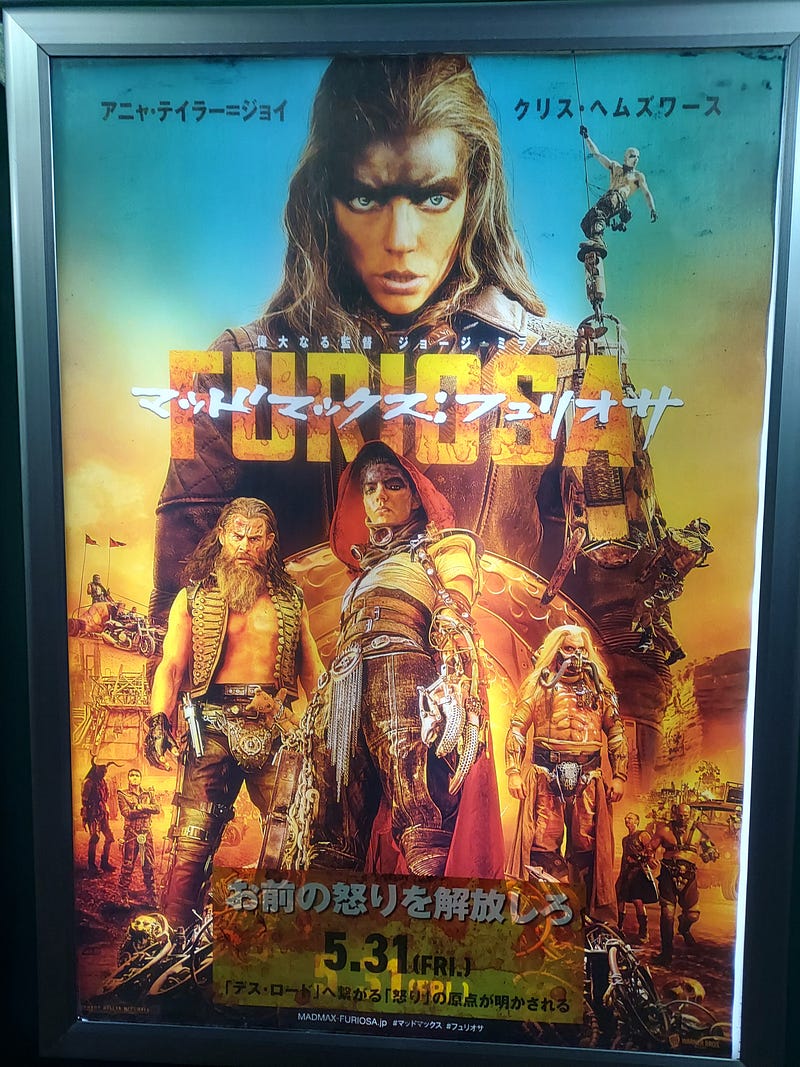
9. Furiosa: A Mad Max Saga
George Miller strikes it out of the park again. The latest Mad Max entry is a worthy successor to Fury Road, focusing on Furiosa, now played by the great Anya Taylor Joy. The film is all that you would expect from Mad Max: violent, hilarious, and extreme. Chris Hemsworth’s villain, in particular, had the best line in the film: “Do you have what it takes to make it epic?”
8. The Eleven Rebels
The Eleven Rebels is a samurai film from Toei that deserves to be remembered as a classic. Its title echoes The Seven Samurai and its plot bears a few similarities. While The Seven Samurai was about the group of warriors who had to defend a village, The Eleven Rebels is about a group of warriors out to defend a vacant military outpost. These warriors, though, are condemned criminals, and they have all signed up for a suicide mission. Like many samurai films, The Eleven Rebels is a social commentary on the abuses of the powerful. The action scenes are bloody and tense, but they don’t obscure the bonds of friendship built between these unlikely heroes.
7. The Brutalist
As much as I liked Martin Scorsese’s Killers of the Flower Moon, I was annoyed by the run time. The film did not need to be four hours long, and at the very least, it’s length demanded an intermission. I thought it was a little hypocritical to insist that audiences see films in theaters, while being inconsiderate of their bladders. This is why The Brutalist endeared itself to me. Like Killers of the Flower Moon, it was also nearly four hours long, but to my bladder’s relief, it had an intermission! Scorsese should take note!
Now critiquing the myth of the “American Dream” is as much a staple Hollywood as the films which extol it: The Godfather, Scarface, El Norte, etc. Another staple of Hollywood is the Holocaust drama: Schindler’s List, Sophie’s Choice, The Pawnbroker, etc. The Brutalist effectively combines them both, which essentially makes it “Oscar bait”, but believe me, this is “Oscar bait” of the highest quality.
The Brutalist is about Lazlo Thoth, (Adrien Brody) a Holocaust survivor and architect who immigrates to America for a new start. As a Jew, however, he is still viewed with suspicion, even by his own family. His re-design of industrialist Harrison Lee Van Buren’s library becomes his key to success. Van Buren (Guy Pearce) envisions a grand mausoleum for his mother, which would also work as a cultural center. As Thoth begins work on this mausoleum, however, he finds that for all he has to offer to America, it can also take more from him than he can bear.
There was a minor controversy over the use of AI to make Brody’s Hungarian sound more authentic. I don’t think this as egregious as using AI to make Karla Sofía Gascón’s singing sound better in Emilia Pérez. Brody’s performance is overwhelmingly human and physical. His acting in the film did not hinge on his Hungarian fluency, at least not with me. Most of his dialogue was in English, anyways. Emilia Pérez, on the other hand, is a musical, the strength of Gascón’s performance is very much dependent on the perceived quality of her singing.
6. Civil War
Civil War is not Alex Garland’s best film, and it can be fairly on-the-nose, but I think it perfectly captures the zeitgeist of American anxieties in the Trump Era. The war in Civil War began in response to the president staying in power for an illegal third term, with Texas and California succeeding in response. The war is from the perspective of a team of journalists, one of whom (Wagner Moura) hopes to interview the president before he possibly dies in the conflict. Kirsten Dunst plays an older journalist who is jaded from all the violence of the war, while Cailee Spaeny plays a young, ambitious journalist who isn’t prepared for what’s coming. Civil War’s ultimate message is anti-American exceptionalism. It puts a mirror to how we are used to seeing conflicts in other countries and says it can’t happen here, too. The best and scariest scene in the whole movie belongs to Jesse Plemons.
5. Blue Period
Blue Period has an unusually high production value for a manga-based adaptation. It’s about Yatora Yaguchi, a Japanese high schooler nearing graduation who decides to join the art club, despite having little experience in art. He gains a passion for it, but will it be enough to get him into art school? Blue Period captures the joys and frustrations of creativity. Not only does it show the strenuous human effort required to create art, but also how our experience influences what we make.
4. A Complete Unknown
Biopics tend to be hit or miss. They’re either awful, conventional, or electric. A Complete Unknown falls into the latter category. Timothy Chamalet plays America’s Bard himself, Bob Dylan, who takes a long journey to New York to see the dying folk singer Woody Guthrie to capture some of his inspiration. Guided along the way by fellow folk singer Pete Seeger (a much-missed Edward Norton), Dylan rises to change the face of folk and rock music in America. We also see Dylan’s turbulent but affecting romance with fellow singer Joan Baez (Monica Barbaro). Dylan may be a musical genius, but it’s clear that he’s a terrible boyfriend. Dylan’s love of experimentation and innovation leads him to embrace the electric guitar, which is much disliked in folk, but despite this controversy, Dylan decides to stay true to his artistry.
Like Sebastian Stan’s Trump in The Apprentice, Chamalet does us the courtesy of not doing an impression. We get a sense of Dylan’s unique character and genius, but unlike The Apprentice, the inner workings of his thinking and personality are not explained. He remains an enigma. Nor do we get any explanations for what his songs mean. We’re left to meditate on that for ourselves. That’s part of the charm of Dylan and his music. Anyone can fill in the blanks of what it’s all supposed to mean based on their own feelings.
3. Wicked
I never saw the Broadway musical that this film was based on, so I essentially came into it blind. I was a fan of the Oz books and 1939 film, but I wasn’t so sure how well this musical would translate onto the big screen. The trailers gave the impression of another CG acid trip, but decided to trust in Jon M. Chu’s direction, given how much I loved Crazy Rich Asians. I instantly was converted to the Wicked fandom after hearing the opening song “No One Mourns The Wicked”, which is still my favorite piece in the whole picture. This is a grand Hollywood musical that not only respects the legacy of the 1939 film, but is also one of the better fantasy films to have come out since Harry Potter ended.
At its simplest, Wicked is a retelling of the Wizard of Oz from the perspective of the Wicked Witch. The film and the musical are both loosely based on a 1995 novel by Gregory Maguire. While the book certainly has its good points, the musical adaptation is the superior, as it zeroes in on the rivalry and friendship of Elphaba and Glinda. Their relationship starts with the irresistible “What Is This Feeling?” and reaches an emotional fever pitch with their dance at Ozdust. I was made an Ariana Grande fan overnight. Nor was I disappointed by the film’s standout number, “Defying Gravity”, which Cynthia Eviro nails by a mile! Wicked thankfully makes an extensive use of sets and costumes, so we do feel like we’re watching a theatrical show, and not a video game. The set for Shiz University could give Hogwarts a run for its money.
Wicked is also the most successful of the film-halving trend that began with Breaking Dawn. The problem with Harry Potter and the Deathly Hallows, Hunger Games Mockingjay, and Dune, is that they all felt two halves of a single film, instead of two individual films in a wider saga. (Don’t even get me started on The Hobbit). Wicked bucks this trend. It feels like an individual film with satisfying character arcs.
Wicked will probably feel familiar to those who have never seen it because the musical has had a clear influence on many Disney movies of the 2010s. Disney attempted its own version of Wicked in Oz the Great and Powerful. Both Maleficent and Cruella recast famous Disney villains in a sympathetic light. While Frozen follows the similar plot of a great witch fearful of her power who later comes to embrace it. Elsa herself is also voiced the first Elphaba, Idina Menzel.
2. Conclave
No doubt, Catholics of a more conservative or orthodox persuasion will likely find this film distasteful, but those of a more liberal spirituality will find it enlightening. I always appreciate religious stories that are willing to break orthodoxy in order to better connect to the more complicated lives of the faithful (e.g. The Last Temptation of Christ, Silence).
Conclave is about the election of a new pope. The cardinals are divided between the liberal and conservative camps. Ralph Fieness plays as Cardinal Lawrence, who is tasked with organizing the conclave and vetting the candidates of any potential issues. In the film, we see that beneath their robes, these cardinals are just as human as the rest of us, and their politics are no less vicious. While some may dismiss the film as anti-Catholic, it essentially makes the same argument that Jesus himself made in the Gospels: that the spirit of the law is more important than the law itself.
1. Flow
In 2000, Disney released the film Dinosaur, their first non-Pixar CG film. The film’s opening sequence was a masterclass in animated storytelling. It silently followed the journey of a dinosaur egg amidst breathtaking vistas and a fabulous score. You’d be mistaken for thinking that this would be the tone of the whole film, but unfortunately the dinosaurs start talking and the rest becomes fairly generic after that. Flow is everything that I wished Dinosaur could have been.
Flow is a Latvian cartoon by Gints Zilbalodis which features a cat who loses his home to a flood and must find refuge in a boat along with other animals. The film is a clear climate change fable that will grow more relevant as sea levels continue to rise. Flow was made using Blender, an open-source 3D software that is often used in video games, which explains the cutscene-like feel of the film. This is not to the Flow’s detriment, however. Zilbalodis has created a fantastical post-human world. He brings us down to the animal’s point-of-view, and though they have character, they stay true to their beastly nature. Being a dialogue-free film, the audience is left to speculate on the plot and how it came to be.
There’s an element of mysticism that elevates Flow to deep spiritual cinema. A character ascends into what may be the afterlife. There’s no explanation as to why or how this happens, or if it’s even real, but we feel it and that’s enough. We don’t get too much of a warning for it, but it happens at just when we need it to, at the film’s lowest moment. That ascension was a brief, awe-inspiring respite amidst a senseless storm. You could even say that in the drudgery of our day-to-day lives, that a great film serves a similar purpose.