Four Ways To Improve The Presidential Debates
I’ve been reflecting on the presidential debates and why we seem to learn so little from them. Televised debates, of course, are far from…
I’ve been reflecting on the presidential debates and why we seem to learn so little from them. Televised debates, of course, are far from the only, or even the best way of educating yourself about the candidates. You’d probably be better served by going through their campaign website, but not everybody has the time to do that, not with so many contenders. So a debate, as I see it, serves three major purposes:
1) For the candidates to plainly introduce their platform
2) For the candidates to distinguish themselves as uniquely qualified
3) To see how well the candidates can handle criticism under pressure
The debates can do this decently enough, but they’ve devolved into infotainment. Donald Trump antics at the Republican debates was akin to throwing Andrew Dice Clay into The West Wing. Part of Trump’s popularity came from the fact that so many found him irresistibly entertaining. Not even his critics could look away. I’ll be the first to admit getting some chuckles from Mango Mussolini, but I should have known better. Not everyone saw him as joke. While some saw The Apprentice as a comedy, others saw it as a documentary. We traded the Republic for bread and circuses.
The media is hardly any better. Tucker Carlson of Fox News behaves more like cartoon character than a journalist and discussions between talking heads on CNN often devolve into shouting matches. Lest we forget, the now-disgraced Les Moonves of CBS once spoke fondly of the ad revenue he received from covering Trump, “It may not be good for America, but it’s damn good for CBS.” It shouldn’t be surprising then that previews for presidential debates often end up resembling action movie trailers. Democratic candidate Andrew Yang hit the nail right on the head in his closing statement,
“You know what the talking heads couldn’t stop talking about after the last debate? It’s not the fact that I’m somehow number four on the stage in national polling. It was the fact that I wasn’t wearing a tie. Instead of talking about automation and our future, including the fact that we automated away 4 million manufacturing jobs, hundreds of thousands right here in Michigan, we’re up here with makeup on our faces and our rehearsed attack lines, playing roles in this reality TV show. It’s one reason why we elected a reality TV star as our president.”
Now is the time we take his advice. It is certainly fair to argue that debating is itself a performance, but they are far from devoid of any educational value. For good or for ill, they remain a popular venue to learn about the candidates. As such, it would be in our collective interest to improve them as much as we are able.
1. No more than seven candidates on stage
Have you have been on Netflix on trying to figure out what to watch, but you have so many choices that it takes you an hour and a half to decide? This a very normal thing, and there’s science behind it. A study from Temple University found that human brains can’t handle complex problems when given too much information. This was the disorienting experience many of us had watching the debates. The DNC apparently thought it a good idea to host twenty candidates debate over two nights. At some point, your eyes just glaze over.
The solution is to reduce the number of candidates on stage and add more debate nights. There should be a rule of no more than seven candidates per night, which is still a lot, but not overwhelmingly so. These past few Democratic debates had twenty open spots. If you divided that over three nights, you would get seven over two nights, and six on one night. If you divided that over four nights, you would get five even over every night. Not only would this make things easier for Americans at home, it would also make things easier for the candidates. They would have more time to speak, and feel less of a need to interrupt, but is only one night enough to cover the issues facing this country?
2. Have each debate address different topics
Foreign policy, health care, immigration, and the economy, are all highly complicated issues that often require well-informed and nuanced answers. This is why we give the candidates only 30 seconds to explain their policies on them. Is it any surprise, then, that people complain about certain issues not getting good coverage? There simply isn’t enough time. Foreign policy alone could be its own debate. Given the time constraints, you cannot expect your preferred topic to be explored in sufficient detail. So why not have each debate address different topics?
Since it’d be impossible to have a debate on every conceivable topic, each debate should cover a group of topics. The number of debates held should depend how the candidates are divided. If, for example, we had twenty candidates for three nights, we would then hold three sets of debates over a seasonal period. The candidates would then be cycled in and out of different topical debates, so by the end of the period, every candidate will have weighed in on each major topic. These debates would also need to be conscious of their location. Debates involving climate change should take place in a local parks by candlelight.
3. Get rid of the audience
The only reason for there to be an audience at a presidential debate is to either ask questions, or to throw tomatoes at the candidates. No matter how much the moderators tell them to keep quiet, the audience will cheer what they like and hiss at what they hate. This will inevitably cause candidates to shape their statements (sometimes unconsciously) to please the audience in the room. The people in that room only represent a small number of voters, whose views might not align with wider public. Bad ideas could be elevated because they make for good rhetoric, and reasonable objections could be dismissed because they aren’t crowd pleasers. It skews the debate away from substance and more towards entertainment. It doesn’t help that personal insults are applauded like an episode of Jerry Springer.
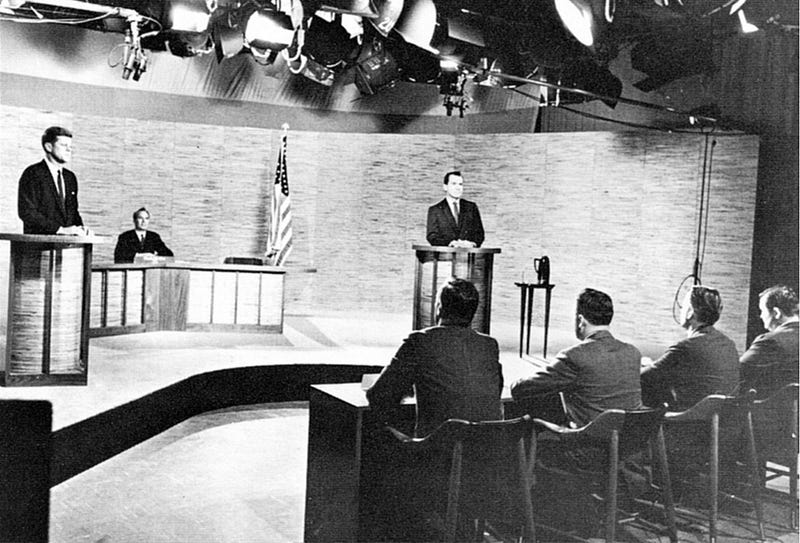
It doesn’t have to be this way. The first televised debate between Nixon and Kennedy in 1960 took place in a Chicago TV studio. No wide audience aside from a few panelists. You may not notice it at first, but something subtle happens when you remove the audience from the equation. The mood becomes somber. Less like a campaign rally and more like a board room meeting. Candidates might speak more freely about what they really stand for and not what will get them standing ovations.
4. Cut the damn mics
In elementary school, whenever the teacher asked a question, only the students who raised their hands would get called on. If you shouted out the answer you were ignored, as you should. Why can’t we do the same for these debates? If a candidate wants to add to an issue, they should raise their hand first. If they shout, their mic gets cut, no exceptions. Discouraging such interruptions would do well to ensure that no time is wasted.
Now, there are right and wrong ways to do this. The timing can’t always be exact, so a candidate should at least be allowed to finish their sentence or idea. The mics should also be cut off silently. One of the Republican debates had an annoying bell that rang off whenever candidates ran out of time. It had the effect of making the debate feel like a game show. Should we bring in Pat Sajak to spin The Wheel of Foreign Crises?
No one likes it when their favorite candidate is cut off, of course, but if these suggestions are followed, then the candidates will have more time to make their case. They won’t be so fearful of outpacing the moderators, and we just might start to have some real presidential debates.