Mother of Peace?
The sordid legacy of Unification Church leader Hak Ja Han
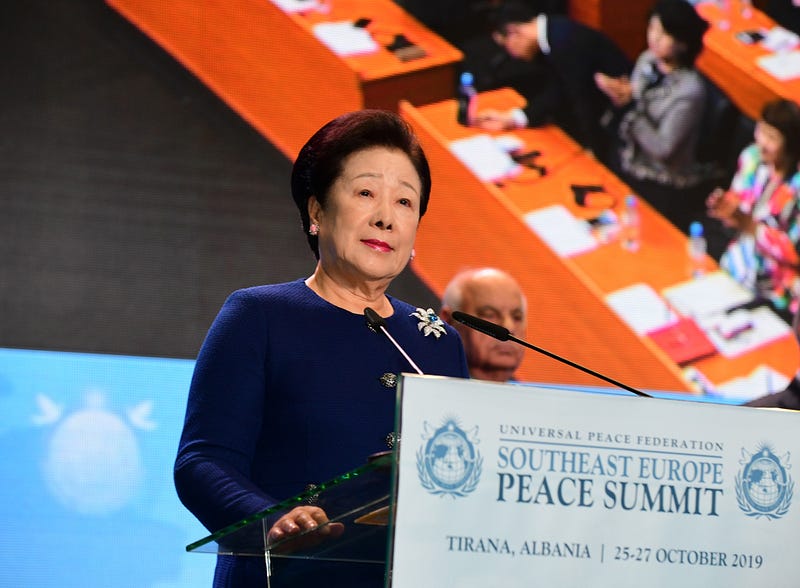
On September 2025, the 82 year old Hak Ja Han, the leader of the Unification Church (UC), was arrested by the South Korean government on bribery charges. A notable capstone on a life that had mostly been spent leading a theocratic crime organization that masquerades as a peace movement. In many ways, Han was often overshadowed the presence of her husband, Sun Myung Moon, who claimed to be the Second Coming of Christ. While she did have a role as the “True Mother” (God’s ideal of motherhood), she always felt somewhat secondary to the “True Father.” Moon, whatever you want to say about him, had a charismatic personality which doesn't seem to have been replicated by his wife.
After Moon’s death in 2011, however, she took his place as the head of UC and is now referred to as the “Mother of Peace.” Her followers would claim that is mostly due to her peace conferences, intercultural events, charitable work, and leadership of a movement which aims to reconcile religions and end conflicts. The UC also refers to her as “Dr.”, even though her only doctorates are honorary. (Two of which were awarded by the UC-affiliated colleges Bridgeport and Sunmoon). Can anyone with an honorary doctorate be called “Dr.” now? Is Jerry Seinfield now Dr. Jerry Seinfield? In any case, far from being any of these things, Han, like her late husband, is a corrupt authoritarian.
Groomed to be Moon’s Bride
“I have in a way trained Mother. She was often so tired, wanting to rest, but I would just pull her around every place and make her do everything. She would be almost exhausted, but she was always willing to obey her husband, and whatever I did she would try to do; wherever I went, she would follow.”
Han was born in Northern Korea in 1943, during the last years of the Japanese occupation and the Second World War. In her 2020 autobiography, Mother of Peace, she describes her birthplace, Anju, as an epicenter of Korean patriotism and Christianity (4). Her mother and grandmother were both deeply involved in the Korean independence movement. Han, though, has a twisted kind of patriotism. She states that Korea’s torturous foreign invasions over the course of its history, were necessary conditions to bring about her birth as the True Mother: “God needed a nation capable of enduring suffering for the sake of all nations. God prepared the Korean people for this” (26). Imagine telling the Korean “comfort women” that their sexual slavery at the hands of the Japanese military was all a part of God’s plan to give them a billionaire messiah.
Han inherited much of this religiosity from her mother, Hong Soon-ae and her grandmother, Jo Won-mo. These matriarchs were members of the New Jesus Church, (one of the many Korean precursors to the UC), which was begun by the charismatic Rev. Lee Yong-Do. They instilled in her the obsession with self-sacrifice that would later be a trademark feature of the UC, writing that “they did not mind carrying out exhausting endeavors that seemed to melt their very bone marrow” and that they “would bow before Jesus hundreds and even thousands of times in a day” (32). Hong also told Han of the constant dreams she had of Satan trying to harm her, which convinced her that Han must be protected from the “pollution of the secular world” (33). Her mother and grandmother also believed that the Christ would come again to Pyongyang, though the communist repression later forced them to leave (37).
Han was introduced to Sun Myung Moon’s Unification Church through their church leader, who read in a newspaper about the Ehwa Women’s University Scandal of 1955. In this scandal, the UC was accused of engaging in sex rituals with female students. Their church leader had heard a prophecy that the Korean messiah would come from group accused of such rituals (62). Rumors of such acts, known as “pikareum”, were not exactly unknown to Korean religious groups of the period, so this oddly specific prophecy isn’t exactly out of left field. In any case, the leader advised Han’s mother to check them out, and she did, eventually converting to the UC after being moved by Moon’s lectures (64).
From here, the story gets unsettling. Han first met Sun Myung Moon briefly at age thirteen, when he was thirty-six, noting to Han’s mother that he found her daughter “pretty” and that Han would make great sacrifices in the future (66). This idea of sacrifice became ingrained her, and she became obsessed with living a life of sacrifice for God (72). All the while, Han was indoctrinated with Moon’s teachings. The core of which is that Adam and Eve failed because they had pre-martial sex, and that to restore this Fall, God’s new Messiah needed to marry and have children. This was Jesus’s original mission, but he was crucified before he could make it happen. Thus this new Messiah, who they all suspected was Moon, would need to marry a perfect bride to fulfill God’s Providence.
She was only seventeen when she met Moon again in 1960, while he was forty years old. He picked Han to be to his bride, in part, due to her youth. He has said that the True Mother could not be a day over eighteen, since Eve fell at sixteen, the New Eve could not be too much older than that. He also added that a younger bride would be easier to control:
“Mother herself needed to be obedient, like a lamb, centering on love. In all respects, she needed to find the condition by which she could be absolutely obedient. Therefore, she needed to utterly sacrifice herself for her husband. In other words, she needed to be absolute in loving her husband. She could not have made comparisons, saying, He is inferior to my father. He is inferior to my brother.
Instead, she had to think of her husband as being superior to any man on earth, be it her teacher, her grandfather, or anyone else. This is because Eve had seen no man other than Adam in the Garden of Eden, and thus she had had no room to think about any other man, or to entertain any other thoughts.”
We have a pretty clear picture of what happened here. Moon groomed a vulnerable teenager to be his servant bride. Given that Han was raised to believe that Moon was the Messiah, she would accept whatever he demanded of her out of divine obligation. Moon could not handle a woman who was his equal. His first wife, Sun Gil-Choi, was less tolerant of his erratic behavior, such as when he abruptly abandoned his wife and newborn son for seven years to evangelize in Pyongyang (Moon, 119–120). He needed a new wife who he could have complete control over, who would be supportive of his every decision, no matter how extreme.
His most severe demand was that Han give birth to at least 12 children. She gave him 14, though it required four C-sections to do so. When she had the third C-section, the doctor even warned her that she might die, but she persevered (Han, 92). As a result of these surgeries, Han noted that she could no longer enter cold swimming pools (115).
The Many Lies of “True Mother”
As with Moon’s similarly whitewashed autobiography, As A Peace-Loving Global Citizen, what isn’t said in Mother of Peace is as revealing as what is. The Moons have a victim complex, believing that any criticisms they receive are due to misinformation, bigotry, or Satan himself. Since Han and her husband are the “True Parents” whose “Divine Principle” is God’s final revelation, any facts which might challenge this claim are to be ignored or misrepresented.
For instance, Han speaks proudly of her husband’s role in supporting U.S. President Richard Nixon during the Watergate scandal of 1972. She makes out Nixon to be some sort of victim who had been abandoned by his political and Christian allies, with only Moon showing the courage to support him (127). The UC rallied to convince America to forgive Nixon so that he might stay in office long enough for to win the ongoing Vietnam War. (127). Moon himself warned in 1973 that a failure to forgive Nixon would plunge the U.S. into a serious moral crisis. For Han, the fruits of this crisis were born out when the communists supposedly convinced America to leave Vietnam, which she blames for causing the Khmer Rouge genocide in Cambodia (182). This is all very misleading.
Even if Moon managed to save Nixon from Watergate, he wouldn’t have stayed in Vietnam. Nixon had no intentions of staying in the unpopular war and was elected on the promise of “peace with honor.” This was evident from Nixon’s “Vietnamization” policy of training the South Vietnamese to handle the war once U.S. troops left. He also signed a face-saving peace deal to allow U.S. withdrawal a full year before he resigned. The war was also unpopular for good reason (even MLK opposed it). Han is notably silent on the many war crimes the U.S. committed in Vietnam, from the My Lai Massacre, to the razing of villages in “fire free zones”, to the bombing of Laos and Cambodia that killed thousands. It was this particular bombing which so destabilized the Cambodia that it helped the Khmer Rouge take power. In fact, Pol Pot’s chief torturer said that Nixon’s bombing “allowed the Khmer Rouge to grasp golden opportunities.” It must also not be forgotten that the ones who ended the Khmer genocide were the Vietnamese communists. Though Nixon resigned, he was essentially forgiven through President Gerald Ford’s pardon, but far from preventing a moral crisis, it crippled U.S. democracy by assuring future presidents that they were above the law. You can draw a straight line from this pardon to Reagan’s Iran-Contra, Bush’s waterboarding, and Trump’s election coup attempt.
Han briefly mentions the 1978 “Koreagate” scandal, where Minnesota Rep. Donald Fraser led a congressional investigation into South Korea’s covert attempts to influence U.S.-Korean relations. Han claims that Moon was only targeted by the investigation because he was Korean and of an unpopular religion, concluding that they found nothing on the UC (134). This is a lie. Han doesn’t mention that in the 1970s, South Korea was under the brutal leadership of dictator Park Chung Hee. His oppressive tactics made many in the U.S. question military aid to South Korea. In an interview with religious scholar Frederick Sontag, Moon suggested that the religious dissidents arrested by Park where trying to overthrow the country (152), and indeed, that any opposition to the Park regime may “invite the aggression of North Korea and the annihilation of the South Korean people” (153). Robert Boettcher (who served on the Fraser committee) wrote in Gifts of Deceit that Fraser’s initial hearings were focused on human rights in South Korea, only shifting when Korean official Lee Jay Hyon testified about KCIA plans to quiet criticism of Park in the U.S. (7–8).
Far from finding nothing, the commission acquired testimony from from ex-member Allen Tate Wood (president of a UC org), who said that Moon sought enough influence to dictate U.S. policy and make the Korean government dependent on him. They also received testimony from ex-member Robert Roland, who learned from Moon’s right-hand man, Bo Hi Pak, that the UC intended to use their culture groups to advance the causes of the Korean government. The commission also released CIA intelligence documents finding that Kim Jong Pil of the KCIA used the UC as a political tool. The commission ultimately concluded that: “While pursuing its own goals, the Moon Organization promoted the interests of the ROK Government, and at times did so in cooperation with, or at the direction of, ROK agencies and officials.” Han’s claims of a witch-hunt fall also apart when you consider that that lobbyist Tongsun Park (not a UC member) was also found guilty of bribery. How is he an innocent victim of an anti-religious purge?
The commission suggested that Congress review whether or not Moon violated U.S. tax laws. This eventually led to a 1982 conviction of failing to pay $7,300 in taxes, for which he was sentenced to 18 months in prison and ordered to pay a $25,000 fine. Han insists that Moon did nothing wrong, noting that many churches hold bank accounts with the pastor’s name. She adds that even if Moon underpaid his taxes, a fine would’ve been sufficient punishment (134–135). Han also refers to Moon’s support from many religious organizations such as the National Council of Churches who saw the conviction as oppression of religious liberty (136). This is likely because they believed this to be a case of Moon simply holding UC assets in his own name.
Han grossly oversimplifies the tax case here. In 1974, Moon opened a U.S. bank account which held income from stocks he earned from his business Tongil Il. This income was then transferred to another account at the same bank. Moon falsely argued that these accounts belonged to the UC and that he didn’t use them for personal purposes. Thus, they owed no income taxes. The jury found, however, that funds intended for the UC often went to accounts explicitly owned by the UC, not Moon. They also found that the accounts in question were used for personal expenses, such as buying stocks, purchasing land, and paying mortgages. The jury further found that Moon ordered his aide, Takeru Kamiyama, to fraudulently backdate documents to make his assets appear to be the UC’s, and thus, not taxable.
As to the religious bigotry accusation, the appeals judge found that the UC’s only evidence for bias was the earlier Fraser investigation (which was mainly about the Park regime), Senator Bob Dole’s request for an audit of the UC’s exempt status (which did not ask for an audit of Moon’s personal accounts), and that a trial-by-jury would be to prejudiced by negative coverage (bench trial is not a right in the U.S. and the jury selection interrogated dozens to minimize bias). If this tax fraud was merely a mistake, I could see a civil trial as more appropriate, but considering that this was willful financial crime, a criminal sentence seems fitting.
Now what would a “True Mother” be without her “True Family?” If you were expecting Han’s perspective on the controversies around the Moon clan, you’d be disappointed. It appears that even when it comes to her own family, Han can’t help but avoid grappling with the uncomfortable truth.
Han is quiet on the spiritual activities of her own mother, Hong Soon-ae, from beyond the grave. Hong, revered in the UC as “Dae Mo Nim”, died in 1989. It is believed that after she died, she possessed a medium known as Kim Hyo Nam and began holding ancestor liberation rituals in Cheongpyeong, Korea (the UC’s Vatican or Mecca, if you will). According to Kim, “each of us has millions of ant-egg-sized evil spirits clinging to us, and that to expel them we must clap repeatedly, bow repeatedly, and slap ourselves and others to get rid of them.” I attended one such ritual in Detroit. It never got violent, but I recall finding it a little weird. This was in the U.S., of course. Cheongpyeong is a different story. UC member Teri Lester wrote in 1999 that she was disturbed by what she saw, “It would be amusing if it were not for the fact that several people have died and many more have become seriously ill, and that children have been mistreated, either by being taken to the workshop or abandoned so their parents could attend.” Yuri, an ex-member who started the UC dissident blog, “How Well Do You Know Your Moon”, told Business Insider that believers beat themselves so hard that they bled. The real Hong Soon-ae may well have approved of these rituals had she lived to see them, considering that she once beat a mentally ill boy to death during a healing ritual. The UC also charges quite a lot for these workshops (e.g. $700 for your father’s first seven ancestors). Of course, the UC provides no evidence that any ancestors are being liberated here. You’ll have to take them at their word.
The first son Han mentions in her autobiography is Heung Jin, who is still revered in a UC as a saint. Heung Jin tragically died in a car accident, but Han reframes this in spiritual terms, stating that he was killed by Satan in his father’s stead (259). As disgusting as it is to exploit your own child’s death to stroke your messiah complex, Han only covers the bare surface of the depravity. She omits the fact that Moon indulged in many mediums claiming to have received messages from Heung Jin. The most infamous of these was Cleophas Kundiona, a Zimbabwean who claimed to be possessed by Heung Jin and beat the sin out of UC members, even sending Moon right hand, Bo Hi Pak, to the hospital.
Han praises her other son Hyo Jin as a genius rock musician who wrote hundreds of songs for the UC and tragically died from the fatigue of his tireless work (260–261). Not a word is spent on the allegations of adultery, cocaine addiction, domestic violence, and sexual abuse against Hyo Jin from his first wife Nansook Hong. Hong wrote in her memoir that Han treated her like a servant and victim-blamed her for the abuse, “She spoke in euphemisms about his violence and his substance abuse, reminding me that it was my duty to work as God’s instrument to change her son” (163).
Notably, Hyun Jin (Preston) Moon and Hyung Jin (Sean) Moon, who are leading splinter groups hostile to the main UC branch are not mentioned. Neither is her daughter In Jin (Tatiana) Moon, whose Lovin’ Life Ministries sought to reform the UC until it was leaked that UC leadership covered up her romantic affairs and child out of wedlock.
Han was also a neglectful parent. For her and Moon, evangelizing was a greater priority than her own children, “…we had so much work to do for the church and the providence, we were unable to spend much time with them” (96). The burden of raising these kids often fell to the members, but since they were the “True Children” the members were often too afraid to discipline them. Perhaps this neglect goes a long way towards explaining why so many Moon children turned out as dysfunctional as they did. Her son Sean Moon (who runs the MAGA splinter group) said that the older siblings were free to terrorize the younger ones, adding, “You would go nuts. You’d go crazy.”
Keep in mind that the promise of the “True Parents” was to build an ideal family, the fulfillment of God’s original plan for humankind, an example for all others to follow. And yet the restrictions on sex were hardly respected, abuse was rampant, the sons broke off into schisms after their father’s death, and the family seems unable to resolve conflict without resorting to insults or lawsuits.
Reign of the Only Begotten Daughter
Sun Myung Moon died at age 92 in 2012. Though he clearly intended for his son, Hyung Jin “Sean” Moon to be his successor (even saying that those who opposed his claims were the “heretic and destroyer”), his wife took the reins of power for herself. Han has since begun to alter the UC theology to emphasize her stature over Moon’s, claiming that she is stronger than Moon, that her husband failed and needed her saving, building a new statue of herself at Cheonpyeong (where Moon is notably smaller), and has ordered revisions of Moon’s texts so as not to contradict her claim to be the “Only Begotten Daughter of God.” This hints that their marriage was not an entirely happy one and that Han resents the level of control Moon had over her life. Before we get to Han’s arrest, it might be fitting to examine the major activities of her tenure as the UC’s head: peace conferences and the Cheon Il Guk Constitution.
The ostensible purpose of these “peace conferences” is to bring global leaders together to solve the world’s problems. This tradition, begun by her husband, also served as a means to curry favor with influential people and boost the UC’s image. When I was a member, seeing photos of Moon with all these distinguished politicians, scholars, and religious leaders, reinforced my belief in his messianic claims. It was very good propaganda. Many are also well-paid, such as U.S. Vice President Mike Pence who was paid $550,000 to speak at one such event in 2023. Of course, the PR boost is mutual. Many controversial figures speak at these events for the prestige of being associated with interfaith and world peace. The prime example being disgraced U.S. President Donald Trump in 2021.
You would think that Trump’s inclusion would expose just how unserious these events are, but you’d be wrong. The “religious liberty” publication Bitter Winter (which defended the UC’s financial abuse in Japan) justified the UC’s invitation of Trump, writing:
“The former American President is so unpopular among many mainline media that it seems that to disqualify an organization it is enough to associate it with Trump. This is what happened to UPF after the 2021 Rally of Hope. Attacks based on Trump’s video participation in the event were either misinformed or malicious. Politicians of all political persuasions participated in this and other UPF events. And, whatever the opinion one may have of Trump, in a conference discussing the relationships between other countries and North Korea, inviting a former American President who had been very much involved in Korean issues should not have been surprising.”
Any “peace group” that proudly headlines endorsements from fascists like Trump will be treated with suspicion, if not outright contempt. Why would a peace organization invite a man who tried to ban Muslims from entering the U.S., who separated migrant children from their families, who pulled the U.S. from the Paris Climate Accords, who funded Saudi war crimes in Yemen, who tore up the Iran Nuclear Deal, and who tried to overturn an election he lost? Of what benefit is this to peace?
It is particularly galling for the UC to tout such an endorsement. Trump is a selfish, racist, sexual predator. If ever a single man were the antithesis of all the values that the UC claims to stand for, it’s him. That is, unless it is now the position of the UC that moral character is irrelevant so long as one praises Han. It also doesn’t seem to bother Han that many top figures in the MAGA cult (including Eric Trump and Donald Trump Jr) are aligned with her estranged son’s militant offshoot.
The defense that it was reasonable to invite Trump on the basis of his Korean “diplomacy” is equally faulty. For starters, Trump’s diplomatic overtures with Kim Jong Un accomplished nothing as far as nuclear weapons and human rights are concerned. What unique insights can Trump provide on peace with North Korea? Trump, as far as I know, didn’t attend any discussions on this matter at the rally. He just gave speech praising Han and left. How does this advance the cause for peace in Korea? The only conclusion we have is that Han wanted the prestige of being endorsed by a U.S. President. Congrats.
Of course, Trump is just one in the rogue’s gallery of corrupt leaders that have indulged in Han’s “peace” events to whitewash their images. These include former U.S. Vice President Dick Cheney (began the Iraq War), U.S. Rep. Newt Gingrich (began the modern era U.S. political polarization), CIA Director and Secretary of State Mike Pompeo (mocked Jamal Khasshogi after his murder), Trump’s spiritual advisor Paula White (warned that anti-Trump Christians will be punished by God), Guatemala President Jimmy Morales (a denier of the Ixil Maya genocide), Cambodia Prime Minister Hun Sen (whose authoritarian rule saw numerous human rights violations), and Philippine President Rodrigo Dueterte (wanted by the International Criminal Court for crimes against humanity).
Now, respectable folks have also attended these UC peace events, like Sarah Gilbert, whose team helped develop the Covid-19 vaccine. The presence of such figures, however, doesn’t cancel out the insidious elevation of the horrible people invited. I understand that diplomacy sometimes involves talking to imperfect leaders, but what have these events accomplished that justifies inviting war criminals and genocide deniers? Even if these peace events led to any positive outcomes, that still wouldn’t erase the wrongs of Han and her husband. The fact that the Gates Foundation has done good work against global disease doesn’t erase the fact that its founder Bill Gates befriended convicted pedophile Jeffrey Epstein.
We also have to ask ourselves what kind of peace it is that the UC wants to build. Moon only saw democracy as a means to an end of spreading his ideology, not as an end in and of itself, “Heaven is not a democratic world. Democracy is useful when there is no true center. Where there is already a true center, do you still want to have an election?” Moon clearly stated way back in 1978 that the goal of the UC is “promoting a God-centered "totalitarianism."” While he assured us that democratic rights would be respected, there were still certain freedoms that he was against. For instance, Moon opposed separation of church and state, as it would “allow satanic forces the freedom to develop unchecked.” Moon also railed against individualism and privacy: “Those who advocate their privacy and extreme individualism are going against the universal law. Therefore, they are bound to perish eventually.” Moon’s theocratic ideal was called the “Cheon Il Guk”, which is Korean for “Kingdom of Heaven on Earth.” On his 88th birthday, Moon told world leaders to build this ideal world by “attending True Parents, who have been enthroned as the King and Queen of Peace in Heaven and on Earth…”
The Cheon Il Guk Constitution wasn’t written until 2014, two years after Moon’s death. Frankly, it reads like a formula for re-creating the North Korean regime. Although Hak Ja Han oversaw its writing, I don’t think Moon would’ve opposed much of it. My personal belief is that Moon mainly hated state communism because it was atheistic, not because it was authoritarian. (Even the “atheistic” charge, while true, must acknowledge the quasi-religious cults of personality around Lenin, Stalin, and Mao). This constitution puts in plain language the kind of world Moon wanted this whole time along.
The “True Parents” as the eternal monarchs of this kingdom (Article 5), have the final decisions over its management (Article 6), and are the sole authorities for who can get married (Article 7). I imagine that once Han dies, the “True Parents” will be the next “True Child” in succession. Since the “True Parents” are God’s representatives, their authority cannot be contested, even if they do unethical things. Of course, only those who attend these “True Parents” can be citizens (Article 19). What happens to those who aren’t citizens isn’t mentioned. Though even citizens can have their rights taken away if they disavow God or “True Parents” (Article 23). No freedom of belief in this system, ironically. Of course, the problem with this constitution is the problem that plagues any theocracy: it assumes that those acting in God’s will have God’s wisdom. Even a cursory view of the UC’s history makes this prospect unlikely.
Free Hak Ja Han?
Now let’s return to September 2025. Han was arrested by the Korean government for allegations that she instructed UC global president Yun Young-ho to bribe the then First Lady Kim Keon Hee, the wife of then South Korean president Yoon Suk Yeol of the Peoples Power Party (PPP). These bribes took the form of a Graff necklace worth 62.2 million won ($42,000 est) and a Chanel bag worth 12.71 million won ($8,500 est) through the shaman Geonjin to get business favors. This was in violation of the Improper Solicitation and Graft Bill which forbids gifts to public figures above a certain threshold. 100 million won ($73,000 est) in bribes were also paid to PPP lawmaker Kweong Seong-dong and another 210 million won ($140,000 est) in UC funds were donated to PPP offices ahead of the election. These acts were also in violation of Article 31 of the Political Funds Act: “No one shall contribute any political funds from any corporation or any organization both at home and abroad.” Han is also accused of destroying evidence of her gambling in the U.S. after learning of a 2022 Korean investigation into in (which is illegal for Koreans both at home and abroad).
This arrest comes after Japan had its own reckoning with the UC after the assassination of former Prime Minister Shinzo Abe in 2022. The UC theology believes in collective guilt, so the Japanese are collectively responsible for their war crimes against Korea during World War II and must pay reparation known as indemnity. This indemnity came in the form of money through “spiritual sales” in which Japanese members are pressured into buying expensive holy objects with threats of ancestral curses. Abe’s assassin, Tetsuya Yamagami, was the son of a UC member, who gave so much to the UC that the family struggled financially. He killed Abe for his attendance at UC events. The aftermath put renewed attention and outrage on the UC’s widespread financial abuses, which led to the UC’s loss of tax exemption in Japan as well as the liquidation of its assets to repay the victims. All of this under Han’s watch, and undoubtedly, putting pressure on the Korean government to act on the UC’s abuses domestically.
In Korea, the UC, while insisting on Han’s innocence, initially expressed regret and said that, “We hope the truth will be revealed and will sincerely cooperate in the legal process.” In the U.S., however, Demian Dunkley, the U.S. President of the UC, called it “a witch hunt. There is no credible evidence, no crime—only political convenience” Sean Moon of the MAGA splinter group could barely hide his schadenfreude, seeing her arrest as divine justice. Bitter Winter’s editor-in-chief, religious scholar Massimo Introvigne, decried the arrest as “religiocide” in his 2025 essay “The Arrest of Mother Han: Korea’s Unholy War on Religion and Reason.”
It is Introvigne’s charge that is most deserving of a response. He is still widely respected as an authority on “new religious movements” so his words will influence how many will see this case. Even though the trial was still underway, with new facts yet to see the light, Introvigne refused to take a patient or agnostic position. He assumed that Han’s arrest was purely discriminatory with no legitimate aims. For a UC member this is expected, but for a religious scholar, this is unprofessional. Not only did Introvigne refuse to ask critical questions or engage sincerely with the facts at hand, but later developments in the case reveal just how overly hasty, arrogant, and sloppy he was.
To be clear, I recognize that UC members can face discrimination and even forcible de-conversion. Such acts must be condemned and individual members should not be punished for the crimes of the Moon family. There are troubling allegations of Han being mistreated in jail, but it isn’t clear if Han is being treated worse than the average prisoner, nor have such allegations been independently verified. That being said, the UC and its defenders seem unable, or perhaps unwilling, to tell the difference between criticism and bigotry.
Bribery
Introvigne can’t refute the bribery charges, so his defense (asserted without proof) is that Korean politicians wouldn’t be so cheap as to accept a $73,000 bribe: “South Korean politicians may be cheap, but in a region troubled by widespread corruption and substantial bribes, the notion that you can buy the ruling party and the President of a G20 country for just $73,000 is absurd.” I wonder if Introvigne is aware of the 2008 cash-for-votes scandal, in which then National Assembly Speaker Park Hee-Tae, attempted to bribe lawmakers with only $2,600 each. Far less than $73,000, but it was still enough to tempt lawmakers. In any case, the $73,000 doesn’t cover the thousands more that the UC was giving to the PPP as well as the luxury gifts.
Introvigne adds that since Han can easily meet with world leaders, she wouldn’t need to bribe them for favors such as the alleged invitation to Yoon’s inauguration, “This from a woman who hosts global summits with presidents and prime ministers—including Donald Trump. The idea that she’d commit a felony for a seat at a domestic ceremony is laughable.” As I noted earlier with Mike Pence, speakers at UC events are often paid. Introvigne thinks it’s impressive that Trump spoke at two UC events, ignoring the fact that Trump was paid $2 million to do so. Also, simply because Han meets with other world leaders doesn’t guarantee that she can make them do whatever she wants. They may expect some form of compensation for certain demands. An invitation to Yoon’s inauguration is far more than a “seat at a domestic ceremony.” It would send a clear message of Han’s influence with the new leadership. This bribery is also about far more than an invitation, but also involves many major plans. Sure enough, a UC official later admitted to the court that many political projects that the UC wanted, “were difficult to advance through the church’s efforts alone.”
When it comes to the alleged motivations of these bribes, Introvigne is dismissive: “And the supposed goal? Influence over a wire agency acquisition and Cambodian business interests. Neither materialized.” Is Introvigne suggesting that bribes are always successful? That no one has ever given a bribe that led to nothing? Maybe there were other factors at play which the bribed actors could not control for? Maybe the changes in political leadership affected it. Maybe the projects were so large as to not materialize all at once? Introvigne is curiously vague on all these details, perhaps because readers might find them compelling.
The “news wire agency acquisition” refers to YTN, which is a major cable 24 hour news channel in Korea. That the UC sought to acquire it is no small thing, as it would give the UC unprecedented influence over the Korean media. As we have seen with their creation of the Washington Times, this would allow for a proliferation of far-right propaganda. There are also reports that Hyun Jin (Preston) Moon’s splinter group sought to acquire YTN in 2023, so the UC’s intentions might’ve been to stop their family competitor.
The “Cambodian business interests” refer to several UC projects in Cambodia, including a peace park in the Mekong River and a new UC regional headquarters for the Asia-Pacific. They began in 2021, with Yun cultivating ties with the Yoon administration to get their help. Yun also gained Cambodian citizenship with help from Prime Minister Hun Sen in 2022 in an effort to more easily purchase land. Sen, as I noted before, has attended Han’s peace events. A major motivation for Yun was to recoup the loss of UC funds that were used during the 2023 Cambodian election in exchange for a casino license in the country. The prosecution does note, however, that on this project Yun acted independently without Han’s knowledge or approval. Not exactly the type of admission that a groundless witch hunt would make.
The prosecution also claims that another motive is the building of a Korea-Japan undersea tunnel. This plan has been a long held dream of the UC. In his autobiography, Moon proposed that it be part of an “International Peace Highway” to connect the whole world together (343). Han also wrote in her autobiography that “An undersea tunnel connecting Busan in Korea with Karatsu in Japan will boost our respective abilities to contribute to the global economy” (179). UC President Yun told prosecutors that during the Moon Jae-In presidency, he gave lawmaker Chun Jae Soo 40 million won ($27,000 est) and two luxury watches to support the tunnel project. Chun even attended 2018 UC rally in Busan, where this undersea tunnel was meant to start. For what it’s worth, the Korea Transport Institute found in 2011 that such a tunnel would cost trillions of won (billions of dollars) and bring little benefit to the economy. So why does the UC continue to pursue it? Korea’s Sunday Journal suggests that the UC not only wants a convenient way to transfer Japanese funds to Korea, but also a means to strengthen its political standing, “Once it reaches the discussion table, government, finance, security, and diplomacy become intertwined at once. Even as a private entity, it becomes a “party to consultation.””
Finally, another major motive for Yun’s bribery is for the UN to open a fifth international office in Korea’s Demilitarized Zone (DMZ) as well as a peace park in the same area. Han mentions both the UN office and the peace park in her autobiography, as one of the major aims of the UC, “If North and South Korea invite the UN to build its fifth office in the DMZ, it will, by that very act alone, turn a theater of war—where so many on both sides of the conflict shed their blood—into a Mecca of peace” (203). While Korean reunification is a noble aim, the UC’s motives are not altogether altruistic. The project caused criticism from within the UC for using government funding to earn real estate profits, “Despite being promoted publicly as a peace and memorial park, the proposed complex more closely resembled a full-scale urban development project…”
Gifts to the First Lady
Introvigne’s weak defense here is simply to take Han at her word, “Mother Han denies involvement, claiming the rogue executive is responsible for the act. Unsurprisingly, he is attempting to shift all blame onto her for his misdeeds.” The possibility that Han might be lying doesn’t seem enter his mind. He is irrationally confident that she is an unimpeachable truth-teller. (Has he read Mother of Peace?) He notes (again without evidence) that the costs of the gifts is “is a fraction of what’s typically high-stakes bribery in Korea.” So if the bribe is smaller than usual it’s suddenly no longer a crime? Does the existence of big bribes cancel out the existence of small bribes? I wonder how well that defense would hold up in court? Introvigne also ignores that well before Han’s arrest, the receipts for these luxury gifts were found in the UC’s national headquarters in Seoul, not in Yun’s personal residence.
Embezzlement
Introvigne doesn’t bother to refute the charge that Han used UC funds for personal purposes, in fact, he sees it as no problem at all, saying that “in religious movements like the Family Federation (and larger ones), the line between personal and organizational finances is often blurred. Donors revere Mother Han as a messianic figure and likely see no distinction between giving to the church and giving to her.” This is the exact same defense that Moon made during his 1981 tax evasion case:
“Moon’s worldwide followers believe him to be ‘potentially the new Messiah.’ From this theological premise the argument is made that Moon personifies the church movement and is indistinguishable from it. Since the Unification Church movement can owe no taxes or income derived from church-related activities, the defense argues that neither can Reverend Moon.”
The appeals court at the time noted that allowing this precedent would “permit church leaders to stand above the law.” Indeed, if this “Messiah defense” were allowed, it would open the door for all kinds of financial exploitation under the guise of religion. How many would start religions just to avoid taxes? Again, according to the prosecution, these funds were used for political bribery. Even if Han were “stealing from her own pocket” as Introvigne says, she was using these funds to violate corruption laws and undermine the separation of religion and state.
Introvigne also clearly hasn’t read Mother of Peace. If he had, he would’ve recalled the following sentence, “We direct that all donations from church members be used for the poor through building schools and other projects” (267). Moon himself told fundraisers in 1980 that their funds would help UC missionaries around the world, “The need for funds is so great that current income could never meet it.” If Han uses UC funds intended for charity and missions for personal extravagance, is that not fraudulent? If Han used UC funds to bribe politicians, is that not corrupt? Is Introvigne suggesting that it’s okay for Han to lie about how UC funds are used?
Destruction of Evidence
Introvigne can’t refute this charge, either, admitting that “the reasons behind Mother Han’s alleged attempts to destroy evidence in Korea in 2022, related to her gambling in the U.S. more than a decade earlier, remain unclear.” This is odd, because earlier in this same essay, he wrote that gambling is illegal for Koreans and that Han’s gambling was well-known for decades. He wonders why she would need to cover up evidence such well-known rumors. Maybe she doesn’t want to go to jail?
Introvigne also asserts (without evidence) that all the documents about Han’s gambling have already been disclosed. This may be partially true, with reports in 2022 that Han and the UC gambled away $42 million. Is it not possible, however, that Han might have additional documents which would help to convict her in court? If these destroyed documents were, after all, the exact same documents that were already in the public domain, then why destroy them? In fact, the Korean officer who drafted the 2022 intelligence report on Han’s illegal gambling testified that his informant would only give him additional documents if they opened a formal investigation. This investigation, however, was archived by the higher-ups due to a lack of evidence, which the officer found strange because “cases have been assigned even with weaker leads.” When you remember that this was during the Yoon presidency, this scuttling makes sense.
Introvigne also defends the gambling itself, citing a 1979 speech where Moon spoke of evangelizing to sinners in Las Vegas. Introvigne compares it to Jesus “eating with publicans and prostitutes.” Notably, nowhere in this speech does Moon defend gambling as an evangelism strategy, clarifying that, “The mere fact that we are in Las Vegas does not mean we are gamblers.” (Moon does suggest it would be nice if a champion gambler used his winnings on his family, but this is meant as a hypothetical). I think if Jesus had sex with prostitutes while preaching to them, people would think of him a little differently. In fact, in 1984 Moon referred to gambling as a “nationwide problem”, the UC’s World Scripture called gambling “a cause people’s downfall in every society”, and in 2009, Moon stated that he came again to Vegas “to change it to a heavenly place. I go to the casino but I have never touched a card.” Of course, Moon lied. His ex-daughter-in-law, Nansook Hong, noted that despite gambling being forbidden in the UC, she saw the True Parents gamble in Las Vegas. Moon’s rationalization was that he had to understand the sin to save the sinners (93). So when the Moons gamble, they do not only violate Korean laws, but also their own. Introvigne assumes a noble motive behind all of this instead of proposing the alternative: Moon and Han liked gambling made up a divine excuse for it.
Inquisition
Introvigne reasons that Han’s arrest is part of a wider political persecution against religious supporters of the impeached President Yoon:
“But in today’s climate, nuance is a crime. Any whiff of past sympathy for the PPP—no matter how qualified or incidental—is now treated as treason. The message from the special prosecutors is clear: if you once dared to shake hands with the wrong party, we’ll slap you in cuffs. Retroactive guilt by association has become the new judicial standard.”
Introvigne had stated in this same essay that Korea is so corrupt that $73,000 bribes are chump change, and yet the moment religious figures are caught in the mix, he is convinced that they are innocent. He refers to the arrests of Pastor’s Lee Young-hoon, Kim Jang-hwan, and Son Hyun-bo, while not even giving lip service to the possibility that they may have committed actual crimes. Introvigne also has yet to mention the shaman Geonjin, who helped facilitate Han’s bribes, as victim of persecution due to his six year jail sentence. This is because Geonjin is indefensible, and Introvigne admitting that the prosecution might be correct here would undermine his claims of baseless persecution.
Introvigne’s claim that any religious figure who so much as sympathized with Yoon will be suspect to arrest isn’t yet borne out by the facts. He ignores that three major religious organizations representing Protestantism, Buddhism, and Catholicism all came out against Yoon’s impeachment. As far as I know, the leaders of these organizations haven’t been arrested, nor have they had their offices raided. While in office, Yoon also met with nine faith leaders representative of Korea’s various religions. As far as I know, none have been arrested. Yoon has also been tied to several shamans. As far as I know, none of them have met Geonjin’s fate.
Introvigne also ignores that the bribery allegations go back to the Moon Jae-In administration. Chun Jae Soo, a Democratic Party (DP) lawmaker, has also been summoned by the prosecution for accepting bribes from the UC. Another DP lawmaker Lim Jong-seong, has also been accused of taking tens of millions of won in UC bribes. While not a religious figures, these men are not members of Yoon’s PPP party. The fact that they are also being caught up in this prosecution hints that this is not simply a single-minded persecution of religious Yoon supporters, but perhaps a genuine attempt to crackdown on earlier corruption.
In conclusion, Introvigne seems to believe being a religious leader should give you free reign to break the law. Even his more recent essay on Han’s arrest refuses grapple with the new information that’s come out since September 2025. He’s too blinded by his own biases in favor of “new religious movements” to give an honest consideration of the UC’s failings. Introvigne would’ve done well to consider the words of UC member Ben Lorentzen (now married to Han’s daughter In Jin), who told members that they should allow the trial to take its course because, “No one is above the law simply because they belong to a church.”
Even if we were to assume that Han was innocent of ordering the bribes, then she still comes off as an incompetent leader who should be removed from UC leadership. Think about it. Her second-in-command used UC funds to engage in bribery during two administrations under her very nose. Does the UC not do yearly audits of its finances?
Conclusions
Han’s statement the court is revealing about her narcissism. She says that she’s dedicated her whole life to educating humanity and serving God as the Mother of Peace. Not a hint that Han in any way regrets her leadership of the UC. Not even a word of remorse over those who have suffered from her religion, or even the courage to take responsibility for the widespread corruption that has happened under her watch. She would have you believe that the UC getting into legal trouble in three democratic nations is purely due to religious persecution. Han claims to be a defenseless martyr, and yet she has more money, influence, and devotion than all ex-members combined. Han began this story as Moon’s victim, but she ends it as his fellow perpetrator.
Bibliography
Boettcher, Robert. Gifts of Deceit. New York: Holt, Rineheart, Winston, 1980. 7–8.
Han, Hak Ja. Mother of Peace. Korea: Gimmyoung Publishing Co., 2020. 4, 26, 32, 33, 37, 62, 64, 66, 72, 92, 96, 115, 127, 134, 135, 152, 153, 182, 259,
Hong, Nansook. In the Shadow of the Moons: My Life in the Reverend Sun Myung Moon’s Family. United Kingdom: Little, Brown & Company, 1998. 93, 163.
Moon, Sun Myung. As A Peace-Loving Global Citizen. United States: Washington Times Foundation, 2011. 119, 120.
Sontag, Frederick. Sun Myung Moon and the Unification Church. Tennessee: Abingdon, 1997. 152, 153. https://www.tparents.org/Moon-Talks/SunMyungMoon77/SunMyungMoon-770000.htm