Reflections on Pope Francis
A decent man in an indecent world
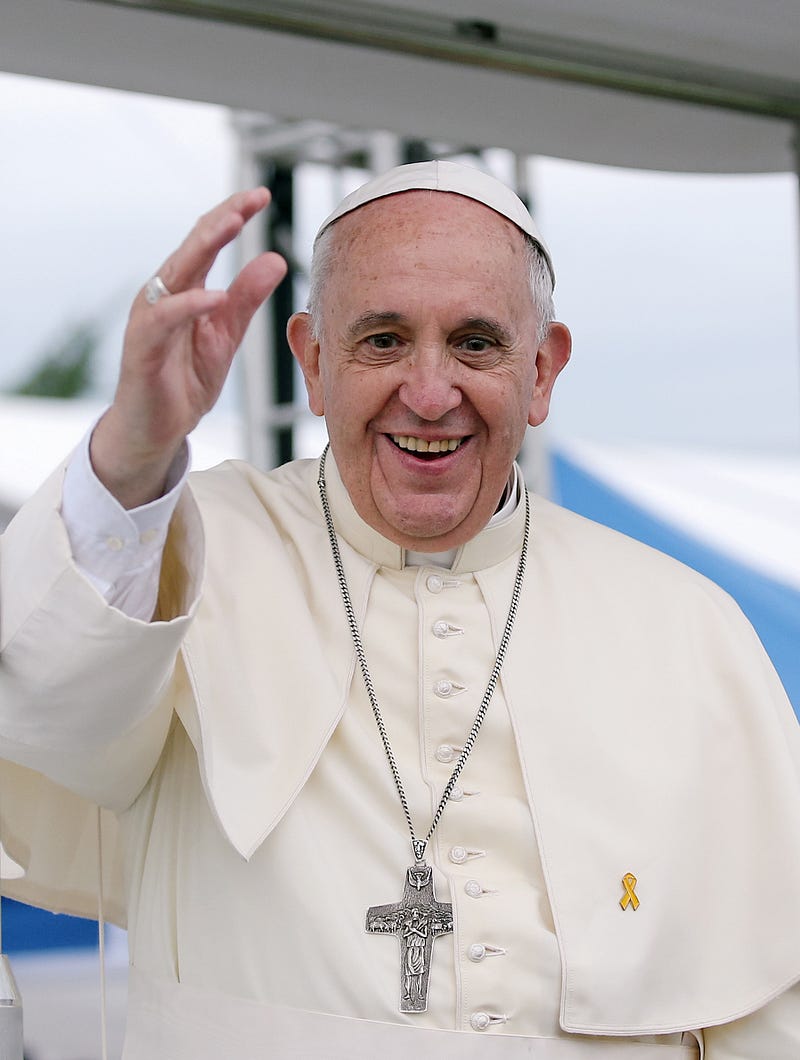
As an agnostic, I had a lot of respect for Pope Francis. Though I grew up Catholic, I’m no longer devout, so it’s a little odd that I’m still sad to hear of Francis’s passing. Whatever criticisms can be said of the Catholic Church, I think it can be agreed that Francis was a decent man who tried to make the world a little tidier than he left it. Such sincerity is much needed and sorely missed in today’s world.
I first read Francis’ Laudato Si in Spanish while I studied in Spain. It was the first papal encyclical I ever read. In Genesis, God refers to humans as the stewards of the Earth, and for Francis, this stewardship meant tackling environmental problems, especially climate change. He referred to climate as the “common good” belonging to all and urged immediate action: “Humanity is called to recognize the need for changes of lifestyle, production and consumption, in order to combat this warming or at least the human causes which produce or aggravate it.”
Francis was also mindful that the effects of climate change would disproportionately harm the poor and marginalized peoples, as he wrote in Laudato Si, “Many of the poor live in areas particularly affected by phenomena related to warming, and their means of subsistence are largely dependent on natural reserves and ecosystemic services such as agriculture, fishing and forestry.” He regularly spoke and advocated for the Amazon’s indigenous peoples, declaring in Querida Amazonia that “We do not need an environmentalism “that is concerned for the biome but ignores the Amazonian peoples”.” These words had a major impact on environmental activism. A study from the University of Manchester found that Pope Francis was a major figure in inspiring many climate activists, not least of which was the Laudato Si movement, which works with 900 Catholic organizations on behalf of climate activism.
Francis was also mindful of the stark inequality of our age. In Evangelii Gaudium, he deplored the ‘economy of exclusion’: “Just as the commandment “Thou shalt not kill” sets a clear limit in order to safeguard the value of human life, today we also have to say “thou shalt not” to an economy of exclusion and inequality. Such an economy kills. How can it be that it is not a news item when an elderly homeless person dies of exposure, but it is news when the stock market loses two points? This is a case of exclusion.” Later in Fratelli Tutti, he extended these criticisms towards the laissez-faire capitalism advocated for by neoliberals, “The marketplace, by itself, cannot resolve every problem, however much we are asked to believe this dogma of neoliberal faith.” Francis was also a vocal proponent of universal basic income for all peoples and higher taxes on billionaires: “Accumulation is not virtuous. Distribution is. Jesus did not accumulate; He multiplied.” For these statements on behalf of the poor, he was often attacked by Christian conservatives like Rush Limbaugh, who accused him of “Marxism.”
Francis was also an unapologetic defender of migrants, who are often driven from their homes due to unimaginable circumstances. Amidst a xenophobic backlash against migrants across the globe, Francis’s call for compassion stood out. His first papal visit was to the crowded island of Lampedusa, where migrants from North Africa had taken a perilous journey to find new lives in Europe. Francis also condemned the sadistic child separations of migrant families by U.S. President Donald Trump as “contrary to Catholic values.”
It is also remarkable that Francis had more moral clarity on Palestine than liberal atheists like Bill Maher (who dismissed pro-Palestine protesters as narcissists) or liberal Democrats like President Joe Biden (who funded Israel’s atrocities in Gaza). The Vatican recognized a State of Palestine as early as 2015. After the start of the Gaza War in 2023, Francis repeatedly called for a ceasefire, called for an international study into possible genocide in Gaza, and spoke with Gazan Catholics gathered in the Holy Family Church nightly. In his final Easter address he reiterated his desire for peace in Palestine, “I appeal to the warring parties: call a ceasefire, release the hostages and come to the aid of a starving people that aspires to a future of peace.”
What endeared many liberals towards the Pope was his rather tolerant outlook towards the LGBT. When asked about whether or not there was a “gay lobby” in the Vatican, Francis famously replied, “If a person is gay and seeks God and has good will, who am I to judge?” When asked by Father James Martin what the LGBT should know about God, he said, “God is Father and he does not disown any of his children.” Francis also supported civil unions for same-sex couples and supported blessings for same-sex couples, saying that, “I bless two people who love each other and I also ask them to pray for me.” And he also opposed laws criminalizing LGBT people, calling it an injustice. Francis also met with transgender sex workers who struggled with poverty. These efforts might seem small to most liberals, but I imagine they meant a lot to LGBT folk living in Catholic households or communities.
That said, Francis was still a conservative at heart who had no interest in upending tradition wholesale. He reiterated that marriage could still only be between a man and a woman. He also applauded the acts of Kim Davis, a former county clerk who refused to issue gay marriage licenses due to her faith. He also denounced gender affirming surgery as threatening to relations between men and women. While Francis did appoint many women to leadership positions, he still refused to let them be ordained. The Protestant Reformation wasn’t perfect, but the fact that there are Protestant Churches more progressive than the Catholic Church speaks to its validity. To name a few examples, the Episcopal Church accepts gay marriage, the United Church of Christ supports gender affirming care, and women have long been ordained in the Methodist Church. Yes, Francis was a reformer, but his commitment to Catholic dogma limited how far he could go.
The gravest institutional problem confronting the Catholic Church is still the sexual abuse of children. Both of Francis’ predecessors, John Paul II and Benedict XVI were aware of the abuse and failed to act as fast as they could. Francis, by contrast, did appear to take the issue more seriously. He acknowledged that he and the Church were often too slow to act on the abuse, he personally asked abuse victims for forgiveness, he defrocked Theodore McCarrick for his crimes against children, he broadened the definition child sex abuse in the Vatican and made it punishable to up to 12 years in prison, and he lifted the pontifical secret law that prevented the Vatican from sharing information on abuse allegations to the authorities.
While we can praise Francis for the steps forward he took, he still failed to bring about the needed systemic change. For example, while he required the clergy to report abuse to their superiors, he did not require them to report such abuse to the police. Also, after French cardinal Jean-Pierre Ricard admitted to sexually abusing a teenage girl, Francis banned him from public ministry, but refused to defrock him or prevent him from possibly ministering to another diocese if he gained his bishop’s permission.
Abuse survivors have been most critical of Francis on this point. Peter Isley, a founder of SNAP (Survivors Network of those Abused by Priests), was disappointed that Francis never made global that change in American canon law that prohibited priests found guilty of sex abuse from serving in the ministry: “Francis needed to complete the work that started in Boston. He needed to complete it and make it global, what began in Boston. And he didn’t do that.” ECA (Ending Clergy Abuse) also shared its disappointment: “Under his leadership, the Church failed to hold bishops accountable for their roles in enabling, concealing, and perpetuating abuse. Systemic change remained elusive. The resignation of a few prelates behind closed doors is no substitute for public accountability. His refusal to remove or discipline those complicit in cover-ups betrayed the Church’s moral obligation to protect the vulnerable.” These failings are also a part of Francis’ legacy. While he did do more than previous popes to address the abuse, he could’ve done far more, and that will leave a dark shadow.
In the end, Francis did not fit neatly into either the progressive or conservative molds, but then again, neither did Jesus. I had my problems with the pope, and I won’t make him out to be more liberal than he was, but in an age where cruelty and indifference are celebrated by the leaders across the globe, it was refreshing to see a leader who still stood for unfashionable values like compassion and empathy. In the end, I think of Francis in the same way that George Orwell thought of Mohandas Gandhi, “compared with the other leading political figures of our time, how clean a smell he has managed to leave behind!”