Rhapsody In Purple
“This wasn’t posing, or marketing. Prince knew early on that he had an extraordinary musical gift. Music flowed through him at all hours…
NOTE: This eulogy was originally written in 2016 after Prince’s passing.
“This wasn’t posing, or marketing. Prince knew early on that he had an extraordinary musical gift. Music flowed through him at all hours, in an outpouring he could barely control. He created constantly, completing a song a day at his peak. The way he explained his musical gifts to himself, friends say, is to believe that he himself was blessed. That contributed to his Jesus complex, but it also made him certain that his music must have a purpose. That purpose became spreading the word of God. Sure, he deviated from that path when he wanted to, but for him there was no need to separate the things we do on Saturday night from the things we do on Sunday morning.”
- Toure, “Prince’s Holy Lust”
The last I heard of Prince, he had released the song “Baltimore” about the killing of Freddie Gray. At the time, I thought it was the best pop song to come out in years. It reminded me of what pop used to sound like, what it was supposed to sound like. It had a catchy hook, a soulful chorus, and a kick-ass guitar solo. The upbeat song also seemed to parallel the actions of one, rather creative protester, who dressed in a leather jacket and danced before the cops to Michael Jackson’s “Beat It.” A laugh in the face of danger. Perhaps we should approach Prince’s passing in such form.
The first song of his I ever heard was “1999” on the radio, and it still remains one of my favorites. I didn’t impress much then, but over time it has come to grow on me. The song was written in the 1982, when fears of nuclear apocalypse were very potent. Though Prince’s year of Armageddon was 2000, the end of the twentieth century. In a 1999 interview, Larry King told Prince his song was rather prophetic, given the fears over Y2K. Though Prince wasn’t worried. Though the background “1999” is grim, the song is an act of rebellion. If he’s to die, fine, but he’ll party like an animal before the bombs fall. A real Bacchanalian.
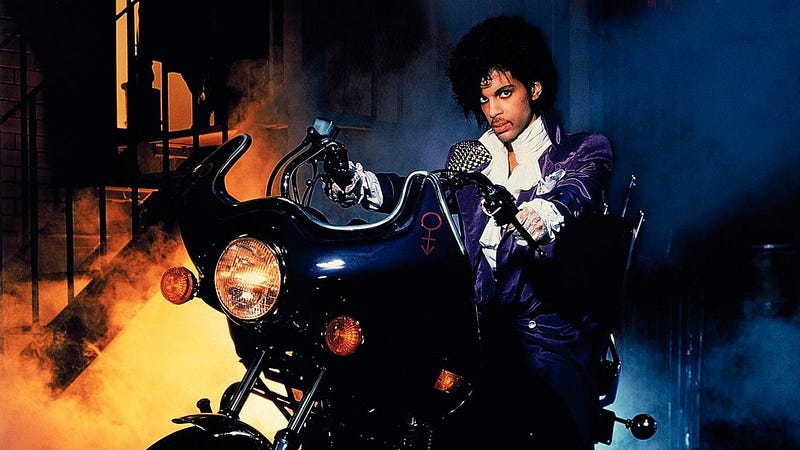
Purple Rain is Prince’s magnum opus. It was the soundtrack to his debut film of the same name. The film, from what I hear, isn’t the greatest, but that’s not what most people remember. It’s the explosion of music in all its varieties. Rarely do movie soundtracks leave such an impact on the pop music scene (only those of Saturday Night Fever and Pulp Fiction come to mind). The album goes into many different places. “Let’s Go Crazy” sounds very much a homage to the bopping beats of Little Richard and James Brown. “The Beautiful Ones” is a soulful and slightly psychedelic dream. “Computer Blue” is essentially an instrumental piece of electric designs. “Darling Nikki” got Prince in trouble with Tipper Gore because it refers to woman masturbating, but regardless, the lyricism of the song is very well done, it almost sounds like a lost Henry Selick song. “When Doves Cry” is one of the more interesting songs on the album, it opens with an intense and impossible guitar intro, before the synth and drum beats take over. Losing the bass guitar isolates Prince’s voice, allowing it some space to echo, which provides for unique listening. The finale of “Purple Rain” is an emotional plea for redemption that ends with a rising guitar outro that breaks open the soul. Purple Rain put Prince alongside Michael Jackson and Madonna as one of supreme pillars of 80’s pop. It went on to become one of the decade’s defining albums. Indeed, Purple Rain is rivaled only by Jackson’s Thriller for best 80’s album.
His skills as a performer were second to none. By now we’ve all seen his scene-stealing guitar solo of George Harrison’s “While My Guitar Gently Weeps” and his phallic flamboyance at the Super Bowl downpour. There’s not much I can add as these shows really speak for themselves. Though there are some lesser known performances worth seeing, such as his thrashing alongside James Brown and Michael Jackson, or his long-suppressed cover of Radiohead’s “Creep” at Coachella. When I see Prince live, he makes me recall two other fallen rock stars, the aforementioned Jackson and David Bowie.
Like Jackson, Prince had the moves, just look at his dancing during live performances of “Little Red Corvette.” Now while MJ was probably the better dancer, Prince more explicitly sexual in his movements (as well as his lyrics). MJ’s sexual charisma had an innocence to it that mirrored what Roger Ebert once wrote about Marilyn Monroe, “she embodied vulnerability and sweetness and hope and fear.” Prince, however, cajoled a divine, sexual enthusiasm that was uncontainable, bold, and irresistible. Prince saw sex as a natural and holy gift, one not to be abused or suppressed. Indeed, it permeates every note of his discography. Like Bowie, he had the glam rock costumes and the feminine falsetto. Whereas Bowie was gender androgynous, Prince was more gender playful, prancing in high heels while swooning the ladies with his shirtless flesh. While Bowie made better songs, Prince made better solos, a guitarist worthy of Robert Johnson, Jimi Hendrix, or Carlos Santana, a talent unparalleled.
As someone who grew up on Motown and Funkadelic in his childhood, and obsessed over The Beatles and The Beach Boys in high school, Prince seemed to capture the best of both genres. He transcended genre. The musicality of Prince reveals just how unexciting and bland much of today’s pop music is (though certainly not all of it). It is difficult to appreciate talent while it lives, and all that much easier to understand when it dies. Ironic that Prince despised the Internet, as he had much in common with it. Though musical tribalism still exists, it’s nowhere near as terrible as it was in years past, where “Disco Sucks” rallies would burn Bee Gees vinyls. The Internet has allowed a new generation of people to explore and discover the best of past with so little of the baggage. Distinctions between rock, funk, punk, rap, pop, hip-hop, blues, R&B, disco, metal, etc have become superfluous. If it sounds good, it is good. The Internet has made it easier to be musically eclectic. Prince’s music did something similar, he was able to bridge black R&B fans with white rock and roll fans, while drawing in the pop-loving teens.
Of course, Prince’s disgust of streaming services ripping off his earnings or pirates torrenting his hits without cost wasn’t unwarranted. He stood proudly defiant in the age of the Internet, as he did against nuclear apocalypse. A reminder that the artist should still be paid for their work. If His Royal Badness has any real fans, perhaps that can still send a message.
Goodnight, Sweet Prince.
“Dearly beloved, this is what it sounds
Like when you become a symbol through sound
That roreth of the crying and the soun:
You give up all your shit, down to the sou,
Wade through raspberry death to find him so
You can remind yourself he once was
- Rowan Ricardo Phillips, “Purple Elegy.”
Originally published at http://sansuthecat.blogspot.com on April 30th, 2016.