The Paradox of Mount Rushmore
Mount Rushmore’s status as an American icon has recently come under fire, due to the bigotry of its sculptor, the sacred Black Hills where…
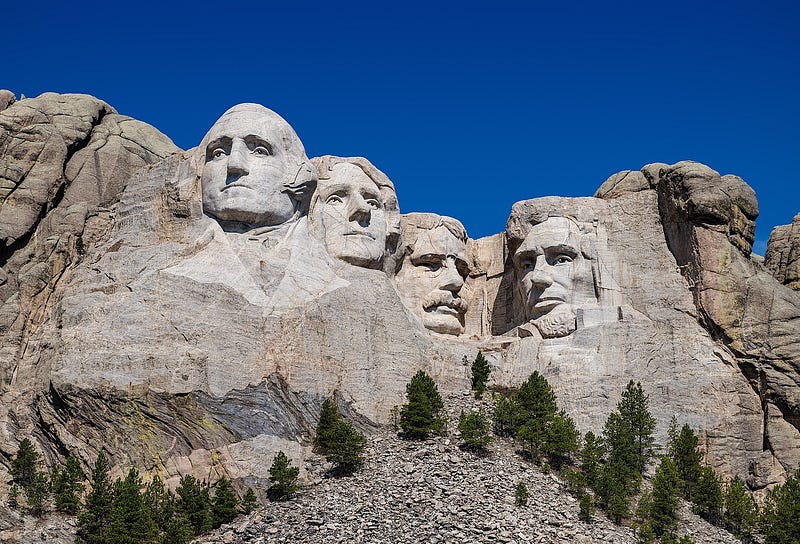
Mount Rushmore’s status as an American icon has recently come under fire, due to the bigotry of its sculptor, the sacred Black Hills where it was formed, and the legacies of the presidents in its stone. Ogala Sioux President Julian Bear and Cheyenne River Sioux Chairman Harold Frazier, have both called for its removal. As has the original sculptor’s great-granddaughter. Mount Rushmore however, has long stood in our public consciousness as a “shrine of democracy.” It has been visited by sixteen presidents, Republican and Democrat, most recently by Donald Trump, who declared in a July the 4th speech that, “Mount Rushmore will stand forever as an eternal tribute to our forefathers and to our freedom.” Addressing this problem, however, demands more thoughtfulness than Trump will let on. The Black Hills stolen from the Sioux should be returned, but Mount Rushmore, instead of removal, should be transformed into the most visible depiction of the American paradox.
Before it was Rushmore, the mountain was known to the Sioux as “The Six Grandfathers”, so named by the medicine man Nicolas Black Elk, who said that it represented the kindness, love, and wisdom of grandfathers. The Black Hills are sacred to the Lakota Sioux because they identify its natural features with many constellations in their cosmology. This respect is often displayed through rituals such as the “Sun Dance.” The area has also been sacred to the Cheyenne, the Kiowa, the Arapaho, and the Crow. As part of an Indian Peace Commission to end conflicts with the Native Americans, the Sioux Treaty of 1868 was signed, which recognized the Black Hills as part of the Great Sioux Reservation for their exclusive use. This treaty was violated in 1874, when miners, led by General George Custer, began prospecting for gold in the Black Hills. The Sioux Nations and Cheyenne heroically fought back, most famously in the Battle of Little Bighorn in 1876 where Custer made his last stand. The U.S. government, however, eventually succeeded in stealing the land in 1877.
In the 1920s, seeking to increase tourism in the Black Hills, South Dakota historian Doane Robinson conceived of a massive sculpture that would memorialize figures of the American West, such as Lewis and Clark and the Ogala Lakota leader Red Cloud. The eventual sculptor for the project was Gutzon Borglum, whose previous major work was a tribute to the Confederacy at Stone Mountain, Georgia. Borglum happily worked with the Ku Klux Klan while designing Stone Mountain and in a letter to a friend in New Jersey, called them “a fine lot of fellows as far as I can learn.” Borglum decided to shift the focus of Robinson’s project into a memorial of America’s “founding, expansion, preservation, and unification.” He thus selected the faces of Presidents George Washington (founding), Thomas Jefferson (growth), Theodore Roosevelt (development), and Abraham Lincoln (preservation). The carving began in 1927 and ended in 1941, not long after Borglum’s death, with only the heads completed (it was intended to go to the waists).
In the years since, the government has tried to make some redress for this injustice. In 1980, the Supreme Court ruled that the Sioux were owed $105 million in compensation due to the treaty violation. The Sioux, however, have refused the money (now worth more than $1 billion) because the Black Hills were never for sale. They only want their ancestral lands back. Further, to many of the Sioux residing in the Black Hills, Mount Rushmore represents one of the most injurious acts of vandalism ever done. As they see it, into their holy mountain were carved the faces of four white men who spearheaded the destruction of their people.
Indeed, the four presidents have all had painful relations with Native Americans. Washington earned the nickname “Town Destroyer” for ordering the “total destruction and devastation” of Iroquois settlements after their repeated raids on the colonies. Jefferson became an architect of Indian land theft, by using a strategy that drove Indians into debt through trade and having them repay it through acreage. Roosevelt used the Dawes Act to uproot Indians from their tribal reservations in an effort to forcibly assimilate them into agricultural society. Lincoln passed the Homestead Act of 1862 which permitted western expansion and Indian displacement, while also overseeing the execution of 38 Indians of the Dakota Uprising.
By telling the complete history of Mount Rushmore, it is hoped that we can elicit greater empathy for the pain of the Sioux. The moral thing for our government can do is to right the wrong of 1877 and return to the Sioux the sacred Black Hills that they most richly deserve. Being a nation that was founded upon religious freedom, restoring to the Sioux ownership of the lands where they desire to worship would be a most appropriate means of honoring that principle.
I also understand that most Americans honor Mount Rushmore as a symbol of democracy, and will continue to do so. Removing Mount Rushmore would most likely provoke a backlash instead of a reflection over its origin. I’d rather that the sculpture had never been built, but its iconography has become an indispensable part of our popular culture, serving as the climax of Alfred Hitchcock’s North by Northwest and inspiring a similar monument in the Japanese manga Naruto. It is also a unique and impressive work of colossal in situ art. Evil art, perhaps, but art still worth keeping.
A public effort to contextualize Mount Rushmore is necessary. To acknowledge its ugly origins does not dishonor our country or the presidents in its stone. It is a sad truth that most nations are founded and developed by land theft, wars of attrition, and ethnic cleansing, and in this, American is no exception, but for those who speak the truth, honor will follow them always. While our forefathers were no doubt complicit in the prejudices of their day, that doesn’t mean that we should also abandon their lessons or pause from appreciating their moral efforts. Even with regards to the Indians, there lies some nuance. Washington signed treaties with Indian tribes to help protect their lands from settlers, had once referred to the murder of three Indians by settlers as “villainy,” and said that stealing Native land would “stain the character of the nation.” Had Lincoln not overseen the Dakota Uprising sentencing, 303 Indians would’ve been executed, instead of the eventual 38. It is for details like these that Mount Rushmore should not be erased alongside Confederate monuments. The men that it honors are worth honoring, but underneath that honor lies a generational failure to halt the systematic murder, oppression, and displacement of the Native American people. No more should Mount Rushmore be a shrine to our democracy, but rather, a symbol of our nation’s paradoxical ideals.
Even some Native Americans agree. Gerard Baker, the first Native American superintendent of Mount Rushmore, who introduced the Indian side of the story to the park, has said that the monument should come to represent the cultural diversity of our country, “This is Mount Rushmore! It’s America! Everybody’s something different here; we’re all different. Ans just maybe that gets us talking again as human beings, as Americans.” While Darrell Red Cloud, who is currently the only presenter of the Native side at the monument, has disagreed with calls to remove the sculpture, arguing instead that the government should “implement a whole program at Mount Rushmore, with statues, some photos, some displays to tell the story of the Native people in their museum.”
Statues are secular idols. The problem with places like Mount Rushmore is that they inevitably help in turning our presidents into demigods. We end up worshiping graven images while the Constitution is set aflame. We do not need Mount Rushmore, or any other statue, to honor the contributions of Washington, Jefferson, Roosevelt, and Lincoln. This is not to say that statues are devoid of any value, but that the ideals which a statue represents are of greater importance than the statue itself. That President Trump, who has shown contempt for the Constitution, can stand before Mount Rushmore as the vanguard of American heritage, reveals the naked hypocrisy of this warped uber-patriotism. What makes a nation great is not colors of its flag or the height of its statues, but its willingness to address its own problems for sake of a more perfect union.
That, my fellow citizens, is true patriotism.