Were There Alternatives to War in Afghanistan?
Should America have negotiated with the Taliban?

In April of this year, President Joe Biden made the difficult decision to end America’s war in Afghanistan after nearly 20 years of failure. Even if you disagree with Biden’s decision to withdraw so soon, it’s hard not to understand his frustration. The Taliban controls more territory now than at any other time since the war began, Al Qaeda and now an offshoot of ISIS are present in the region, and some of our Afghan military allies keep child sex slaves. Is it any surprise, then, that one our top generals assessed that we had only achieved a “modicum of success” in the war?
Opponents of the withdrawal often cite the fragile gains in women’s rights as a reason to stay. Now, while there have been improvements in Afghan women’s rights, the nation is still regarded as one of the worst places in the world to be born a woman. There are others, like Afghan women’s rights activist, Fawzia Koofi, who doesn’t want U.S. troops to leave until a peace settlement is reached. However, there are other Afghan women’s rights activists, like Malalai Joya, and Afghan feminist organizations, like RAWA, who have long opposed America’s military presence as counterproductive to their liberation.
If a peace deal is not made between the Afghans, the withdrawal may lead to civil war, or worse, a Taliban takeover. Now, this outcome is far from certain and there is still time for hope. The withdrawal, however, may be long overdue. The suggested alternative to leaving Afghanistan appears to be a war without end, against an enemy who can never be defeated, and for a government who can often be just as criminal. The Afghan War is an impossible problem with no good solutions. It makes one ask the question, could this whole, terrible intervention have been avoided in the first place?
Bush’s demands and Omar’s refusals
After 9/11, Americans were hurt, united, and furious. Four planes filled with civilians were crashed into the World Trade Center, the Pentagon, and a field in Shanksville, Pennsylvania. 2,996 innocent people died, more than 6,000 were injured, and many still continue to suffer cancer from the fallout. It was right for America to want to bring Osama bin Laden and Al Qaeda to justice for this atrocity. Bin Laden and Al Qaeda had previously been responsible for planning the 1998 US Embassy bombings in Kenya and Tanzania, which had slain 224 people and injured 5,000, as well as the USS Cole attack in 2000 that killed 17 sailors and injured 37. He and his group had been a problem for America and its allies for some time now. In 2001, Bin Laden was believed to be in Afghanistan, which by that point, had been under Taliban rule since 1996.
The day after 9/11, the Taliban’s supreme leader, Mullah Omar, put out a statement condemning the attacks, but denied Bin Laden’s involvement. Bin Laden himself also denied responsibility (though he later admitted to it in 2004). On September 20th, before a joint session of Congress, President George W. Bush made several demands of the Taliban: hand over all leaders of Al-Qaeda, close all terrorist training camps, and give America complete access to these camps. Bush warned them that these demands were not up for negotiation.
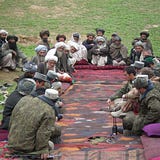
A few days earlier, on September 14th, when Pakistan’s General of the Inter-Services Intelligence, Mahmud Ahmed, conveyed these demands to Mullah Omar, the Taliban chief was “not negative on all points.” He would, however, still have to hear the advice of a council of Afghan elders. On the same day as Bush’s address to Congress, this council of Taliban clerics decided that the United Nations and the Council of Islamic Conference should do an independent investigation into the 9/11 attacks. They also advised Bin Laden to leave Afghanistan while warning America against invasion. While experts in the region praised the move, the Taliban’s Pakistani ambassador, Mullah Zaeef, insisted that Bin Laden would not be surrendered. The Bush Administration dismissed the council’s decree as insufficient.
The very next day, on September 21st, Zaeef warned that Afghans were ready for war, and would defeat the Americans just as they had the British and the Soviets. Zaeef, however, said that the Taliban would be open to working with the Americans if they provided evidence of Bin Laden’s guilt. The Bush Administration, however, had already dismissed this proposal as a delaying tactic when it was once earlier suggested by Omar.
On September 24th, Pakistan’s General Ahmed told the Bush Administration of his plan to persuade Omar to hand over Bin Laden and the other terrorists. He warned the Bush Administration that war would not bring true victory, to quote a declassified memo from the State Department:
“ ‘I implore you,’ Mahmoud told the Ambassador, ‘not to act in anger. Real victory will come in negotiations.’ He said the Taliban were weak and ill-prepared to face an American onslaught. Omar himself, he said, is frightened. That much was clear in his last meeting. ‘We should get the Afghans to do this job for us,’ Mahmoud continued. ‘Reasoning with them to get rid of terrorism will be better than the use of brute force. If the strategic objective is Al Qaeda and UBL, it is better for the Afghans to do it. We could avoid the fallout.’ If the Taliban are eliminated, he said, Afghanistan will revert to warlordism.’ ”
On September 29th, the New York Times reported that Ahmed’s group of Islamic clerics had failed to convince Omar to hand over Bin Laden. The clerics spent hours talking, praying, and sipping tea with Omar, but to no avail. At most, Omar said that he would “think about” the demands.
By October 3rd, war was looking inevitable, but the New York Times reported that the Taliban were open to negotiation, specifically about the possibility of handing Bin Laden over to a third country. They still, however, demanded evidence of Bin Laden’s involvement in 9/11. The Taliban’s Zaeef again appealed to Bush: “We and our people and all the Afghan people need food, need aid, need shelter, not war.”
When a representative at the State Department was asked by a reporter about the Taliban’s request for evidence, it was soundly dismissed as nothing more than a stall for time:
“My response, first of all, is that strikes me as a request for delay and prevarication rather than any serious request. And second of all, they’re already overdue. They are already required by the United Nations resolutions that relate to the bombings in East Africa to turn over al-Qaida, to turn over their leadership, and to shut down the network of operations in their country. There should be no further delay. There is no cause to ask for anything else. They are already under this international obligation, and they have to meet it.”
On October 5th, the Pakistani government said that they were satisfied with the evidence that America had shared with them regarding Bin Laden’s guilt. This was the first such declaration from an Islamic country, and more significantly, it was from the only country that acknowledged the Taliban as a legitimate government. The Taliban stated that if the U.S. shared this evidence with them, that they would try Bin Laden in an Afghan court. Instead, a summary of this evidence was publicly put online by U.K. Prime Minister Tony Blair.
Despite this public release, the Taliban still demanded to see the evidence the U.S. had shared with other countries, which was probably more detailed than the online summary. A frustrated Bush yet again rejected this demand, saying, “The Taliban has been given the opportunity to surrender all the terrorists in Afghanistan and to close down their camps and operations. Full warning has been given, and time is running out.”
Shortly thereafter, the bombing of the Taliban regime began on October 7th, the opening salvo of America’s longest war. By October 14th, the Taliban offered to discuss handing over Bin Laden to a third country if evidence of guilt was given. They would only do this if there was a halt in the bombings. Bush rejected the offer as non-negotiable. On October 16th, Taliban minister Mullah Muttawakil dropped the demand for evidence against Bin Laden and offered to hand him over to a third country if the bombing was stopped. The offer was again dismissed. Muttawakil had hoped that a pause in the bombing would have allowed him and other Taliban members some time to persuade Omar, but there was no guarantee of this succeeding.
The rest is history.
What if?
There are many questions that I can’t stop asking myself: What if Bush had taken up one of the Taliban’s multiple offers to negotiate? What if we had simply given Omar the evidence he so terribly wanted to see? What if we halted the bombings in October and gave Muttawakil time to try and persuade Omar? What if?
Now, I realize that the Taliban’s demands are very unfair to us. They wanted Bin Laden to be tried in either an Islamic court or in a third country. Bin Laden attacked American soil, so it is only right that he be tried according to our laws, or at least those that we recognize. The only third country I could see Bin Laden being extradited to is the Netherlands, where he would face justice at the International Criminal Court. The Taliban also had nothing to say about America’s other demands, such as handing over other Al Qaeda members and the destruction of the terrorist camps. They might not have been willing to go that far.
This is where negotiation comes in. America could have tried to persuade the Taliban to see things our way. We could have given them all the evidence we had at our disposal. We could have impressed on them the seriousness of our military threats. Maybe the negotiations might have fallen through and the Taliban might have stayed recalcitrant. Fine. They might have been more amenable after the first days of the bombing, when we know that they had offered to negotiate at least twice. Things can happen when people talk, but the U.S. never entertained such possibilities, to quote then-Ambassador to Pakistan, Wendy Chamberlain, “The time for dialogue was finished as of 9/11.” This hard stance made the war a foregone conclusion.
While it may be easy to put all the blame on electing Bush for the war, I can hardly see the outcome being any different were Al Gore in office. After all, only one Democrat, Barbara Lee, voted against the Authorization for the Use of Military Force in 2001. On the campaign trail, Bush promised to make America more humble in foreign policy matters. He probably didn’t expect that humility to be so strenuously tested, but given America’s anger at the time, it’s hard to imagine any other president acting that differently. If you take a look at the polls recorded between 2001 and 2002, the overwhelming majority of Americans (as high as 94%) supported military action in response to 9/11. Interestingly, a Gallup International poll taken from 37 countries in late September 2001, found that the majorities of most countries preferred extradition and trial over military action. The U.S., Israel, and India were the only exceptions.
It’s bad enough to be the president while your country suffers the worst terror attack in its history, but imagine being the leader who wasted time “negotiating” while the culprits ran free? Military action seemed like the natural thing to do. And why shouldn’t we do it? We have the most powerful military in the history of the world. We could make short work of the Taliban and Al Qaeda, couldn’t we? We wouldn’t get stuck in a quagmire like the Soviets. We were a democratic country. This wouldn’t be another Vietnam. Ho Chi Minh, after all, didn’t attack us like Al Qaeda did. We don’t need to negotiate with people like the Taliban. Indeed. Such arrogance was best crystalized by the the late columnist Christopher Hitchens, who wrote in 2001, “It was obvious from the very start that the United States had no alternative but to do what it has done. It was also obvious that defeat was impossible. The Taliban will soon be history.”

Now, agency should not be denied to the Taliban here, specifically to its then-leader, Mullah Omar. The Taliban’s authoritarian rule of Afghanistan added to its ongoing humanitarian crisis, which was then compounded by the U.S. intervention. 9/11 might never have happened had the Taliban not given Bin Laden and his thugs the space to plan it. Omar had been given multiple opportunities before and after 9/11 to hand over Al Qaeda, and he arrogantly refused. His own naivete about American military threats didn’t help, either. To quote again from the Taliban’s Zaeef, “In Mullah Omar’s mind there was a less than 10% chance that America would resort to anything beyond threats, and so an attack was unlikely.” He partially brought this war on himself.
I also realize that these negotiations, even if they were successful, probably would have ended in some form of compromise. That’s not what a lot of Americans wanted, but that’s how most negotiations end. It wouldn’t have been perfect, but consider the alternative. Consider that, by one estimate, between 3,100 and 3,600 Afghan civilians died as a direct result of the initial U.S. bombing. In 2001, the U.N. Commissioner of Human Rights, Mary Robinson, warned on October 14th that if there was not a pause in the bombing, Afghanistan could face a “Rwanda-style” disaster. Sure enough, as Guardian columnist Jonathan Steele noted in May 2002, as many as 20,000 Afghans may have died as an indirect result of the U.S. intervention. Bin Laden himself wasn’t killed until ten years after the start of the invasion, and even then, it was by a SEAL Team 6 raid in Pakistan. Did we need a whole war for that?

In the end, we’ll never know how negotiations would have turned out, because the U.S. never pursued them. I cannot promise that the Afghanistan War would have been averted had we spoken with the Taliban, maybe this was all inevitable as soon as the towers fell, but I still can’t help but think…
What if?