Reflections on a Visit to Seoul
Korea has much to celebrate and much to teach us in America

2025 marked South Korea’s 80th year of independence from Imperial Japan. When I visited Hiroshima and Nagasaki, the sentiment from the memorials was that war should be avoided wherever possible and that atom bombs should never be used again. A good sentiment, but one slightly different from what I felt in Korea. There was also a belief that the horrors of war should never again be repeated, but the lesson was that the best way to prevent war is through self-defense. That if you don't defend yourself, no one else will defend you. It is a feeling that must resonate with Ukraine and Taiwan right now. The Second World War was not even Japan's first invasion of Korea. That was the Imjin War of 1592, which was successfully outdone thanks in no small part to Admiral Yi Sun-Sin, whose statute now stands tall in Seoul.
In the years since its liberation, Korea has grown into a prosperous democratic nation, and its culture is now a powerhouse on the world stage. From the literature of Han Kang and Park Seolyeon, to the films Park Chan Wook and Bong Joon Ho, to the music of S.E.S. and SimSim, to dramas like Squid Game and Alchemy of Souls. South Korea’s continued success has many lessons for the rest of us on how to build and nurture a democracy. I visited the nation last year to have fun, yes, but also to humble myself and learn.
It was all such a unique experience to me. I am a former member of the Unification Church, a religious cult founded by Korean billionaire Sun Myung Moon. Moon was a messiah claimant who promised that his movement would bring about an ideal world. Moon constantly referred to Korea as the New Israel, a nation chosen by God to be the foundation of his heavenly kingdom. As a result, the beliefs and practices of the Unification Church have a very Korean nationalist bent. The group, for example, teaches that the Korean language is the language of heaven. (Hangul is pretty easy to pick up compared to Japanese kanji). I spent much of my life associating all things Korea with that religion, and it’s been a long journey to unlearn that. On my trip, I wanted to disassociate Korea from that idealized filter and appreciate it on its own terms.
There was so much to appreciate, too. The trains in Korea are convenient, safe, and clean. As an American, I can't help but envy the ease with which Koreans can travel from one end of the country to the other. Much like Japan, Korea's ancient history can be easily seen and touched. I saw the beautiful Gyeongbokgung Palace, the royal center of the Joseon Period. I was in awe of the rich architecture and wondered what it might have been like to have been a royal at this time. Korea also had a variety of delicious foods, like gimbap, which reminded me a lot of sushi, except that it was cheaper and more filling. Many of the Koreans I met with couldn't speak a lot of English, but they were very kind and quite direct. An attitude I found to be somewhat refreshing after living so long in Japan.
I also have a fun anecdote to share. I'm a fanatic for fried chicken. Frequenting Korean restaurants in Japan has made me obsessed with Korean fried chicken, particularly the sweet and spicy yangnyeom. After spending almost half an hour on the streets searching for a place, I finally found a small spot. One of the customers there could speak a little English, but I found another customer who could speak fluent Japanese. From there, he served as my interpreter. I had a great night, but I drank a little too much soju.
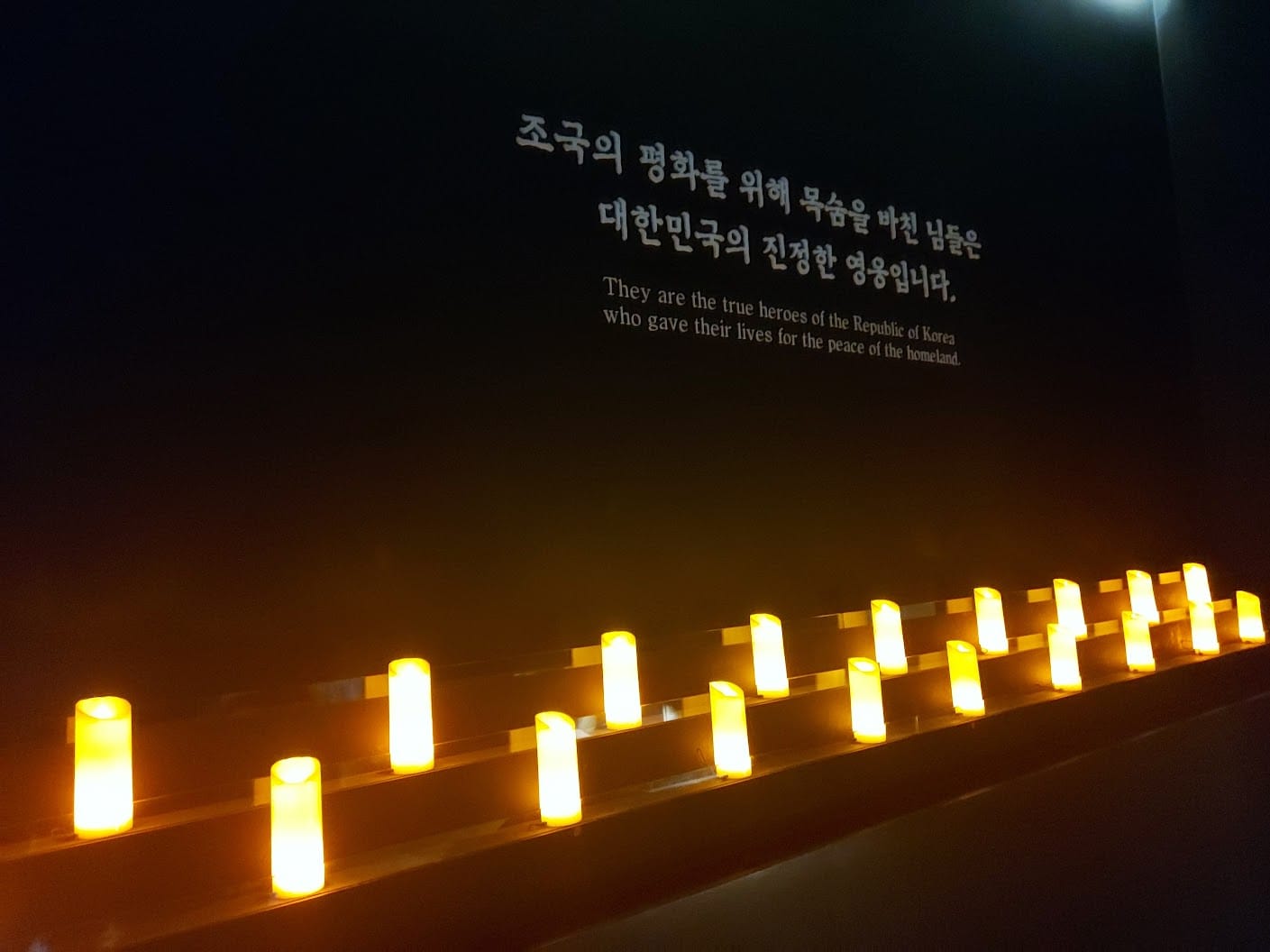
The Korean War has long been referred to as “The Forgotten War” in the United States. This is because it was sandwiched between the Second World War and the Vietnam War. This war is not forgotten in South Korea. I visited the Korean War Memorial, where the flags of all the nations who fought on Korea's behalf are raised high. For all its crimes, and there were many, the intervention against North Korea's invasion saved the South from the authoritarianism of Juche. A slavish cult which millions of North Koreans still suffer under to this day. While the war did end in a frustrating armistice, with dictatorships in both the North and the South, it still gave the South Koreans a degree of freedom to decide their own destiny. A liberty which, while stifled, would not likely have been as successful had the South been under the iron curtain of the North.
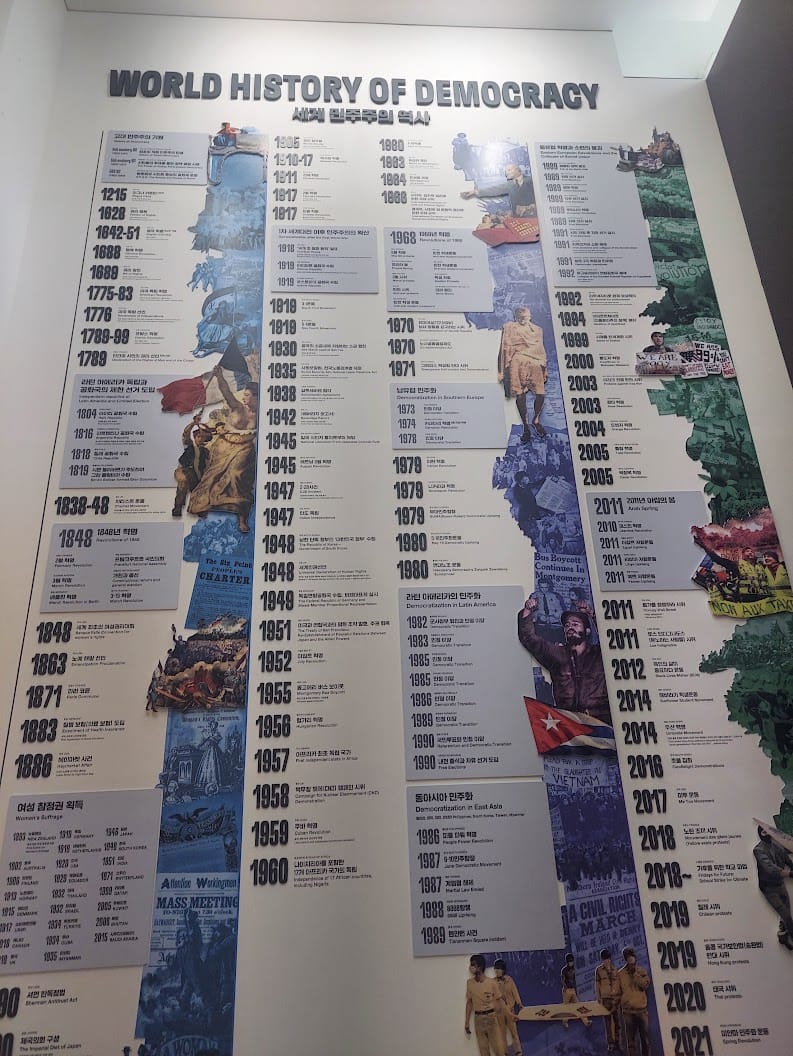
I also visited the Museum of Democracy. It was dedicated to all those who fought and died for Korea's next liberation, that from its own dictatorship. What moved me the most about this museum was the solidarity that took place across so many different levels of society: college students, journalists, artists, Buddhists, Christians, and even taxi drivers. The great Korean film A Taxi Driver, which covered the 1980 Gwangju Uprising, instantly flashed through my mind. I was in awe of the courage of the ordinary people who stood up to tyranny when it seemed so impossible. That we could all be so brave. That we could all be so united.
We saw that bravery on display again when the Koreans rose up against President Yoon Suk-Yeol, in response to his declaration of martial law in a craven attempt to seize power. Thousands of Koreans from all political stripes massed on Seoul's National Assembly in protest, with one brave woman, Ahn Gwi Ryeong, going so far as to grab a soldier's gun. One must also commend the courage of lawmaker Lee Jae Myung, who livestreamed his climbing over the fence to vote to end the emergency declaration. Yoon was later impeached from office and sentenced to life in prison. Myung, on the other hand, was elected president in a landslide. South Korean democracy seems to be working a hell of a lot better than America's. They met their authoritarian moment and passed the test, while we failed miserably.
2026 marks 250 years since America declared its independence from Britain. It's a birthday that feels a lot more like a funeral. The King of Britain even had give a speech to Congress to remind them of the importance of checks and balances. America can no longer be called a functioning democracy. It is an autocratic oligarchy that deteriorates further into fascism by the day. Nor can it be said that the actions of the government do not represent the people. When South Korea's leader tried to destroy democracy, they impeached and imprisoned him. When America's leader attempted a coup after an election, we re-elected him with congressional majorities, giving him free reign to do as he pleased. After ten years in the political spotlight and one previous term in office, Americans cannot plead ignorance as to what Trump was all about. He promised fire and fury against liberals, immigrants, minorities, women, allied nations, public health, and the environment. The average American voter was either on board with Trump's sadism, or too single-minded to care.
This isn’t to say that Korea doesn’t also have its share of problems. Misogyny and income inequality remain two prominent issues. Yoon himself was elected on an anti-feminist backlash. We find that many Korean men would rather blame feminism instead of capitalism for their struggling job market. It's the same story in many countries and America is no exception. Wherever misogyny and poverty are rooted, the temptation of fascism is never far behind. The moral arc of the universe doesn't bend towards progress on its own. That progress has to be maintained through continual work. Not only through education about history and civic duty, but also through the cultivation of the human spirit, and the provision of economic welfare for all.
Even so, Americans would still do well to learn from the Koreans on how to preserve democracy. While Trumpism represents who we are, it doesn't represent all that we are. Think of the No Kings protests and the pro-Palestinian protests against tyranny and genocide. Think of the heroes Renee Good and Alex Pretti, who were murdered for resisting anti-immigrant stormtroopers. Think of the election of democratic socialist Zohran Mamdani to Mayor of New York City and of LGBT rights activist Sarah McBride to the Senate, the first transgender person to be so represented. The human spirit ultimately yearns for liberty, equality, and prosperity. It cannot be held in bondage forever. However blind it may be for the moment, it will, with proper goading, see the light again.
We should all recall the words of the great Kim Dae-Jung, the Korean Nelson Mandela, who was kidnapped and imprisoned for his resistance to the Park Chung Hee regime. Upon his release, he was soon elected to the presidency and sought reconciliation with the North. In his Nobel Peace Prize speech, he spoke to his belief that over the great course of history, justice will inevitably win out:
"Another faith is my belief in the justice of history. In 1980, I was sentenced to death by the military regime. For six months in prison, I awaited the execution day. Often, I shuddered with fear of death. But I would find calm in the fact of history that justice ultimately prevails. I was then, and am still, an avid reader of history. And I knew that in all ages, in all places, he who lives a righteous life dedicated to his people and humanity may not be victorious, may meet a gruesome end in his lifetime, but will be triumphant and honored in history; he who wins by injustice may dominate the present day, but history will always judge him to be a shameful loser. There can be no exception."
May South Korea continue to prosper as an example for us all.